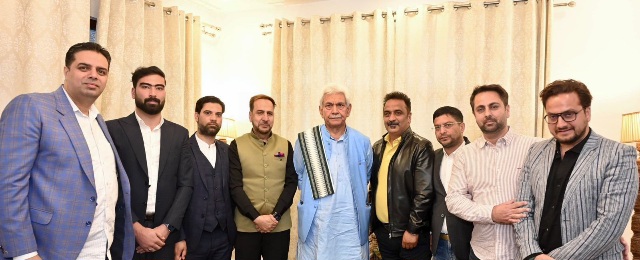
Srinagar, May 5: A high-level delegation of the Chamber of Commerce and Industries Kashmir (CCIK) on Sunday met Manoj Sinha at Lok Bhawan to discuss a wide range of economic, industrial and policy issues affecting the business community across Jammu and Kashmir.
The delegation was led by CCIK President Tariq Ghani and included Senior Vice President Hussain Khan, Junior Vice President Dr Imran Nazir, Joint Secretary Aatif Khan, Chief Coordinator Ashiq Bhat, Treasurer Aijaz, Convenor Umar Jan Wani and youth representative Zubair.
During the meeting, the Chamber submitted a detailed memorandum outlining key concerns and recommendations aimed at strengthening the region’s economic landscape.
Among the issues highlighted were challenges related to land acquisition and compensation, with the delegation calling for fair and transparent mechanisms for affected stakeholders. Concerns were also raised over provisions in the proposed Master Plan 2035, particularly those seen as restrictive for land use and economic activity, with suggestions for a more balanced development approach.
The delegation emphasised the need to improve ease of doing business by simplifying procedures such as hotel renewals, change of land use (CLU) processes and regulatory approvals. It also flagged delays in payments to micro, small and medium enterprises (MSMEs), urging immediate resolution to ensure financial stability for small businesses.
Tourism development, a key sector of the local economy, also featured prominently in the discussions. CCIK called for opening new tourist destinations, upgrading infrastructure and removing regulatory bottlenecks to boost visitor inflow.
The Chamber further stressed the importance of sustainable growth, advocating promotion of solar energy, electric vehicle infrastructure and eco-friendly industrial practices. It also sought upgradation of industrial estates and greater transparency in allotment processes.
Highlighting the need to protect traditional sectors, the delegation pushed for mandatory geographical indication (GI) tagging and stricter differentiation between handmade and machine-made products to preserve the authenticity of Kashmiri handicrafts. Revival of the carpet industry was also flagged as a priority.
The delegation appreciated the Lieutenant Governor’s initiatives, including the anti-drug campaign, and reiterated its support for building a drug-free society. It also proposed setting up rehabilitation centres in every district to assist affected individuals.
The Lieutenant Governor gave a patient hearing to the issues raised and assured the delegation that the concerns would be examined for appropriate action.
Speaking after the meeting, Tariq Ghani said the Chamber remains committed to working closely with the administration to ensure balanced economic development, protection of traditional industries and improved ease of doing business in Jammu and Kashmir.
He also appreciated the role of the Srinagar administration, including Divisional Commissioner Anshul Garg, Deputy Commissioner Akshay Labroo, and the police, particularly Senior Superintendent of Police Sandeep Chakravarthy, for their support to the business community.
The meeting is seen as part of ongoing engagement between trade bodies and the administration to address key economic challenges and promote sustainable growth in the region.