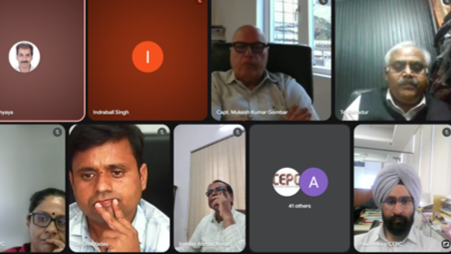
Srinagar, April 13: The Carpet Export Promotion Council (CEPC) on Monday organised a webinar to sensitise exporters on India’s new labour laws and their implications for the handmade carpet industry.
The session, attended by over 50 registered member exporters, focused on creating awareness about the recently introduced labour codes and their impact on compliance, workforce management and business operations.
Dr. Smita Nagarkoti, Executive Director (Officiating), CEPC, welcomed participants and outlined the importance of the session in helping exporters understand evolving regulatory frameworks.
In his keynote address, CEPC Chairman Capt. Mukesh Kumar Gombar highlighted the objective of the webinar, stating that it aimed to equip industry stakeholders with knowledge to adapt to the changing labour law landscape.
Dr. Sanjay Upadhyay, Senior Fellow at the V.V. Giri National Labour Institute, provided an overview of the government’s consolidation of 29 labour laws into four labour codes. He said the reforms are intended to simplify compliance, expand social security coverage, formalise the workforce, and promote ease of doing business while ensuring worker protection.
He elaborated on the four key codes—the Code on Wages (2019), the Code on Social Security (2020), the Occupational Safety, Health and Working Conditions Code (2020), and the Industrial Relations Code (2020)—noting that their effective implementation could strengthen both economic growth and social justice, particularly for artisans in the carpet sector.
Former Deputy Chief Labour Commissioner (Central) Tej Bahadur also addressed the participants, focusing on practical aspects of the new framework. He explained the implications of revised wage definitions on provident fund (PF), Employees’ State Insurance (ESI), gratuity and leave encashment, and highlighted key compliance considerations for employers.
He also discussed issues related to contract labour, including the division of financial responsibilities between contractors and principal employers, as well as provisions governing leave encashment.
During an interactive session, experts responded to queries raised by exporters, clarifying concerns related to implementation and compliance.
Concluding the programme, CEPC Vice-Chairman Aslam Mahboob described the session as highly beneficial for industry members and thanked the speakers, officials and participants for their engagement.
The council said the webinar served as a useful platform for dialogue and knowledge-sharing, helping exporters better prepare for the transition to the new labour law regime.