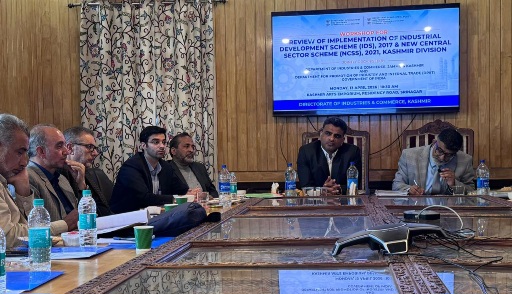
Srinagar, April 13: The Federation of Chambers of Industries Kashmir (FCIK) on Monday raised serious concerns over what it termed as “deep imbalances” in the implementation of the New Central Sector Scheme (NCSS) 2021, calling for urgent corrective measures to ensure equitable industrial growth across Jammu and Kashmir.
The concerns were voiced during a stakeholders’ workshop organised by the Directorate of Industries and Commerce, attended by senior officials from the Department for Promotion of Industry and Internal Trade (DPIIT). The session was chaired by DPIIT Director Rajesh Panwar and moderated by Director Industries and Commerce Khalid Majeed.
Presenting its assessment, the FCIK delegation highlighted that the benefits of the NCSS appear to be concentrated in a few districts, largely excluding other parts of the Union Territory. It said such skewed distribution undermines the objective of balanced regional development and mirrors patterns seen under earlier industrial packages.
The Federation pointed out that out of the ₹28,400 crore scheme outlay, nearly ₹20,000 crore is likely to be availed by just 18 large industrial units, raising concerns about equity and inclusiveness in policy implementation.
FCIK also flagged the continued exclusion of existing industrial units from the scheme’s benefits, stating that these enterprises—despite sustaining operations through challenging conditions—have not been provided adequate support for revival or expansion.
Calling for a course correction, the Federation urged the government to ensure equitable allocation of incentives across all districts and to create a dedicated window for existing units focusing on rehabilitation, expansion, and capacity utilisation. It also proposed a bridge funding mechanism in the range of ₹5,000–10,000 crore to revive idle capacity and potentially generate large-scale employment.
The industry body further highlighted procedural bottlenecks affecting even registered units. It noted delays in the disbursement of GST-linked incentives and criticised the continued requirement for extensive physical documentation despite provisions for online processing.
Concerns were also raised about the exclusion of certain entrepreneurs who had applied within stipulated timelines and made significant investments but were left out due to technical or procedural reasons. FCIK urged authorities to consider such cases under a separate category for inclusion.
Sector-specific issues were also brought to the fore, including the exclusion of key components in mini hydel projects from incentive calculations and the limited recognition of civil works costs. The Federation also questioned the practice of restricting incentives on imported machinery to ex-factory costs, excluding duties and freight, terming it impractical.
Overall, FCIK expressed dissatisfaction over what it described as a widening gap between policy intent and ground-level implementation, stating that procedural rigidity and restrictive interpretation have diluted the scheme’s effectiveness.
Officials from DPIIT assured stakeholders that the concerns would be examined, even as industry representatives stressed the need for more responsive and inclusive policy execution to support sustainable industrial growth in Jammu and Kashmir.