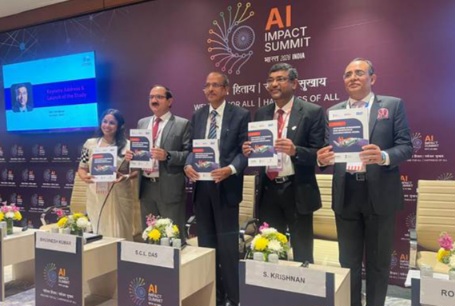
New Delhi: A high-level thematic session on “Advancing AI Readiness and Adoption in Manufacturing MSMEs” was held on the second day of the India AI Impact Summit 2026 in the national capital, bringing together senior government officials, policymakers, industry representatives and academia.
The session saw participation from key ministries, including the Ministry of Electronics and Information Technology (MeitY), Ministry of Micro, Small and Medium Enterprises, Ministry of Textiles, and the Department of Pharmaceuticals.
During the event, a joint study by the National Institute of Smart Governance (NISG) and Athena Infonomics was launched under the aegis of MeitY and the India AI Mission. The study aims to develop a practical and operational roadmap to accelerate artificial intelligence (AI) adoption in manufacturing MSMEs across sectors such as textiles, pharmaceuticals—including medical devices—and electronics.
The research will cover more than 350 MSME manufacturing units across India, gathering shop-floor and management-level insights to identify AI interventions that can improve unit economics, enhance product-service extensions and expand global market access. Officials said the findings would help shape MSME adoption pathways and guide targeted government interventions to boost manufacturing output, export competitiveness and employment.
Addressing the session, Shri S. Krishnan, Secretary, MeitY, said the India AI Mission is committed to ensuring that AI has a meaningful impact on real sectors of the economy, particularly manufacturing MSMEs. He emphasised the need to harness AI to enhance productivity, efficiency and capabilities within the sector.
Shri S. C. L. Das, Secretary, MSME, described AI as a “great force multiplier” and said industry would drive the AI-powered transformation of the Indian economy towards Atmanirbhar Bharat. He underlined the importance of integrating AI at the shop-floor level to enhance MSME competitiveness.
Citing the Economic Survey 2025–26, officials noted that the MSME sector contributes about 31.1 per cent of India’s GDP, 35.4 per cent of total manufacturing output and 48.6 per cent of exports. With manufacturing central to India’s ambition of becoming a $35 trillion economy by 2047, speakers stressed the need for faster technology adoption, improved access to finance and stronger market linkages.
Shri Bhuvnesh Kumar, CEO of NISG, said the study would provide an implementable roadmap for AI adoption and play a pivotal role in India’s journey to becoming the world’s third-largest economy.
Shri Rohit Kansal, Additional Secretary, Ministry of Textiles, said India’s AI dividend would ultimately be realised on the factory floor, particularly in modernising legacy sectors such as textiles and food processing. Shri Aman Sharma, Joint Secretary, Department of Pharmaceuticals, added that AI could significantly reduce costs and improve production quality in a sector where MSMEs account for over 80 per cent of manufacturing units.
The session formed a key component of the Summit’s broader agenda to promote structured dialogue, knowledge exchange and coordinated action to strengthen AI adoption across India’s industrial ecosystem.