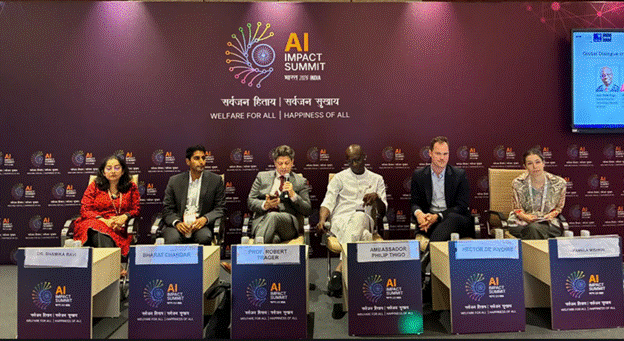
New Delhi: Labour market resilience and the future of work in the age of artificial intelligence (AI) were at the centre of discussions during a high-level session at the India AI Impact Summit 2026 on Monday.
The session, titled “Global Dialogue on AI Usage – Data for Labour Market Resilience,” examined how accelerating AI adoption is reshaping employment patterns and the policy responses required to manage the transition. Drawing on emerging international evidence, panellists noted that AI’s impact varies across age groups, sectors and geographies, with early trends indicating employment pressures for younger workers in roles with higher AI exposure.
Participants highlighted that the lack of comprehensive and comparable cross-country data remains a major constraint in designing timely and targeted interventions. Despite imperfect data, experts called for adaptive policy frameworks, stronger social protection systems and expanded re-skilling pathways to cushion the impact of technological disruption.
Smt. Shamika Ravi, Member of the Economic Advisory Council to the Prime Minister, said India ranks among the countries with the highest levels of firm-level AI adoption, marked by openness and optimism. She noted that while productivity gains are still being measured, AI in India is likely to address long-standing challenges in health, education and services, particularly where last-mile delivery constraints have limited outcomes.
Yoshua Bengio, professor at the Université de Montréal and a leading global AI expert, warned that AI’s impact on jobs observed over the past five years is likely to intensify. He said access to AI would become a competitive advantage, while countries lacking such access could face disadvantages. Bengio called for international coordination and alliances to mitigate adverse effects and steer AI development in a direction beneficial to all.
Ambassador Philip Thigo, Special Envoy for Technology, Republic of Kenya, stressed that preparing for AI-driven transitions requires not only reskilling and upskilling but also robust social protection systems, particularly in countries with young populations and ageing workers in key sectors such as agriculture.
Mr. Hector de Revoire, Director of Responsible AI Public Policy at Microsoft, pointed out that most available evidence on AI’s employment impact is concentrated in a few countries, especially the United States, leaving significant data gaps in emerging economies.
Ms. Pamela Mishkin, Researcher at OpenAI, said resilience should focus on preparing for multiple possible scenarios rather than waiting for perfect data. She cautioned that delaying action until comprehensive usage data is available could leave workers vulnerable during rapid transitions.
Mr. Bharat Chandar of the Stanford Digital Economy Lab highlighted the distinction between AI exposure and actual AI adoption at the firm level. He said jobs with higher AI exposure have shown significant employment declines among younger workers, while firm-level adoption presents mixed effects, underscoring the need for better data on executive expectations and productivity impacts.
The session concluded that building labour market resilience in the AI era will require improved measurement of technology adoption, anticipatory governance and coordinated investments in skills development, social protection and institutional capacity to ensure productivity gains translate into inclusive economic growth.