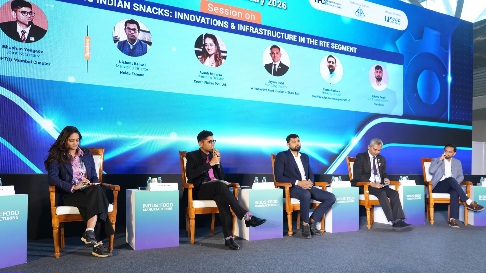
New Delhi: The Indian snack industry is undergoing a shift towards scientific processing, standardisation and infrastructure-led growth as manufacturers seek to position traditional snacks as globally competitive ready-to-eat (RTE) products, industry experts said at Indusfood Manufacturing 2026.
The transition was discussed during a session titled “Scaling Indian Snacks: Innovations and Infrastructure in the RTE Segment”, chaired by food technologist Bhushan Namdeorao Yengade, Founder of Binder Technology Consultancy. The session brought together food technologists, equipment manufacturers and industry executives to examine challenges and opportunities in scaling Indian snacks for domestic and international markets.
Presenting findings from an Asia-Pacific snack market study conducted by Binder Technology Consultancy, Yengade said global consumer preferences are shifting from impulse-led snacking to what he described as “mindful indulgence,” with greater emphasis on nutrition, transparency and functional benefits. He noted increasing demand for high-protein and clean-label products, prompting manufacturers to re-engineer traditional Indian snacks using modern food science and controlled processing methods.
Panelists noted that as Indian snack brands expand beyond regional markets, infrastructure and process engineering become critical. Nishant Bansal, Managing Director of Noida Fabcon, said scale-up challenges often arise in material handling, thermal process stability and packaging automation rather than in product formulation. He pointed to feeding systems, conveying efficiency and process consistency as key constraints in high-speed manufacturing environments.
The importance of ingredient standardisation was highlighted by Avanti Murarka, Managing Director of Crown Flakes Pvt. Ltd., who discussed the role of dehydrated potato ingredients in modern snack formats. She said maintaining uniformity in hydration behaviour, granule size and texture is essential for consistent output in large-scale production, particularly for automated forming and frying lines.
Addressing the export potential of Indian street foods, Jayesh Patel, Managing Director of A Innovative Food Products (SharEat), said converting products such as pani puri and chaat into fast-moving consumer goods (FMCG) for global markets requires strict adherence to food safety and quality norms. He emphasised the need for recipe engineering, automated spice processing, moisture control and hygienic packaging to meet international regulatory standards.
Chetan Dakhore, Managing Director of Shri Vibracion Technologies, drew attention to the role of hygienic material handling systems in ensuring product quality and operational efficiency. He said issues such as breakage, seasoning loss and dust generation can affect both yield and brand perception, and advocated for conveying systems designed to minimise contamination and facilitate easy cleaning.
Technological advances in frying and thermal processing were also discussed. Krishna Pandit, CEO and Managing Director of Fry & Bake Technologies, said direct-heating frying systems and continuous oil filtration technologies are enabling manufacturers to reduce oil degradation and consumption while improving product quality and nutritional profiles.
In his concluding remarks, Yengade said the industry’s focus should extend beyond capacity expansion to long-term strategic planning. He noted that integrating advanced processing technologies, robust quality systems and data-driven innovation would be key to establishing India as a global hub for science-led food manufacturing.
Industry participants agreed that the Indian snack sector is entering a new phase of growth, driven by modern infrastructure and technology while retaining traditional flavours, positioning it to compete more effectively in the global RTE snack market.