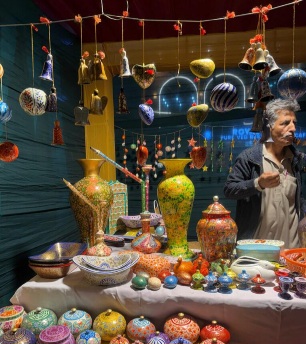
New Delhi: The India International Trade Fair (IITF), one of the country’s largest and most diverse trade exhibitions, is underway at Bharat Mandapam with an expansive showcase of crafts, culture and enterprise from across India — including the celebrated arts and crafts of Kashmir. Now in its 44th edition and themed ‘Ek Bharat Shreshtha Bharat’, the fair features partner states, focus states, central ministries, MSMEs, start-ups, global participants and craft communities, together reflecting India’s cultural depth and economic vibrancy.
Spread across multi-product halls, state pavilions and international sections, the event offers visitors a panoramic experience of India’s artistic and linguistic diversity. The Kashmir Pavilion has emerged as a major attraction with its display of world-renowned papier-mâché, walnut wood carving, Pashmina shawls, Sozni embroidery, Kani weaves, copperware and handwoven carpets — drawing steady crowds alongside stalls from Jharkhand’s tribal art, Uttar Pradesh’s metalwork and Rajasthan’s block-printed textiles. Terracotta ware, bamboo craft, jute products, tribal jewellery and hand-embroidered textiles further enrich the visual tapestry, while State Day performances and workshops reinforce the fair’s message of unity in diversity.
Craft Communities Find Market Access and Recognition
For artisans — including several representing Kashmir’s textile and woodcarving heritage — IITF remains a crucial platform for livelihood security, cultural preservation and direct market access. Exhibitors say the fair provides rare opportunities to engage with domestic and international buyers, negotiate orders and build long-term networks.
Paitkar artists from Jharkhand noted that the platform helps revive ancient scroll-painting traditions. Madhubani painters from Bihar said the appreciation they receive at IITF strengthens the art form’s visibility among younger audiences.
Traditional cowbell makers from Kutch described how their craft has evolved into decorative and musical forms, while Rajasthan’s jutti artisans emphasised that IITF sustains handmade leathercrafts amid rising machine-made competition. Handloom clusters from several states — including those representing Kashmir’s intricate weaving traditions — said the fair remains one of the few spaces where regional weaves find large national audiences.
Stories from the Stalls
Dr. G. Dasaradha Chari, a wood-carving artisan from Tirupati, said IITF has been crucial to introducing the finesse of his work to diverse visitors.
“Even when we make contemporary items, the technique remains the same,” he said. “The fair allows people to understand the workmanship involved.”
Debaki Parida, who practises Dhokra art in Odisha, said her brass figurines tell the cultural stories of her community.
“IITF gives small artisans like us the confidence that our heritage is valued,” she said.
Assamese cane and bamboo artisan Dhiraj noted that each item sold supports multiple livelihoods.
“People come here and truly see the skill behind every piece,” he said.
Madhuri Singh, a Bihar-based artisan making clay and jute dolls, said the exposure helps inspire young women in her community to take up the craft.
“At IITF, people understand the cultural relevance behind each doll,” she said.
Celebrating Unity in Craft — With Kashmir at the Forefront
This year’s edition sees Kashmir’s craft legacy stand proudly alongside other regional traditions. Pashmina weavers share space with Madhubani painters; Sozni and Kani artisans display their work beside Dhokra metalworkers; and Kashmir’s walnut wood carving resonates visually with Tirupati’s temple carvings — forming a collective narrative of India’s artisanal heritage.
As the fair winds down each evening, what remains is the vivid reminder that India’s strength lies in the harmony of its many crafts and cultures. With Kashmir’s artistry standing out as one of the fair’s highlights, IITF continues to embody the spirit of Ek Bharat Shreshtha Bharat, reinforcing that the country’s cultural and economic stories are deeply interwoven — and that its artisans remain at their heart.