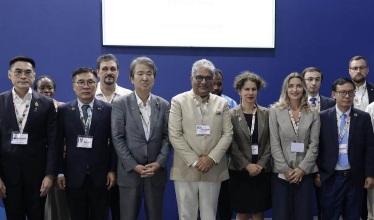
Belém (Brazil), Nov 20: India described the Joint Crediting Mechanism (JCM) as a crucial tool for advancing equitable and scalable climate action during the 11th JCM Partner Countries’ Meeting held on the sidelines of UNFCCC CoP30 in Belém, Brazil, on Wednesday.
Union Environment Minister Bhupender Yadav, participating in the session organised by Japan’s Ministry of the Environment, said the mechanism will help accelerate low-carbon technologies and support India’s climate commitments under its Nationally Determined Contributions (NDCs). The meeting was chaired by Japan’s Minister of the Environment, Hirotaka Ishihara, and attended by ministers and representatives from JCM partner nations.
Opening the session, Mr. Ishihara said the JCM has expanded its partnership to 31 countries and now has more than 280 projects aligned with Article 6 of the Paris Agreement. He said Japan aims to broaden the mechanism’s global reach by encouraging long-term investments, enabling wider participation in climate-resilience projects and strengthening capacity-building support for partner countries.
In his remarks, Mr. Yadav said cooperative mechanisms such as the JCM are becoming increasingly important as countries look for scalable, technology-driven climate solutions. He said the mechanism offers a “significant approach” to advancing climate action while supporting national development priorities, particularly in the Global South. He also noted India and Japan’s long-standing partnership in climate and technology cooperation.
Referring to the India–Japan memorandum of cooperation signed in August 2025, the minister said the JCM provides a structured framework for developing mitigation projects, mobilising finance, deploying advanced technologies and transparently allocating emission reductions. He said the mechanism complements multilateral processes under Article 6 and can deliver mutually beneficial outcomes.
Mr. Yadav said the JCM is expected to contribute directly to India’s NDCs and its long-term low-emission development pathway. He highlighted that low-carbon technologies approved by India’s National Designated Agency under Article 6 will play a central role in catalysing national climate goals. The mechanism, he added, is also expected to help build a domestic ecosystem for advanced technologies and support India’s sustainable development agenda.
He informed partner countries that implementation frameworks are progressing well, with rules and activity-cycle documents nearing completion. The Bureau of Energy Efficiency is developing the Indian Carbon Market portal, which will include a dedicated module for the JCM and other Article 6 cooperative approaches to ensure transparent and efficient project facilitation.
Looking ahead, the minister said JCM projects are likely to cover priority areas such as renewable energy with storage, sustainable aviation fuel, compressed biogas, green hydrogen, green ammonia and high-efficiency technologies for hard-to-abate sectors including steel, cement and chemicals. These sectors, he said, align closely with India’s development priorities and offer substantial scope for collaboration.
Reaffirming India’s commitment to strengthening climate cooperation, Mr. Yadav said the partnership with Japan demonstrates how high-integrity cooperative mechanisms can drive investment and technology deployment while supporting implementation of the Paris Agreement. He called for collective global action to make the JCM “a model for transparent, impactful and equitable climate partnerships.”