“Deer aayey durust aayey — “better late than never.” This old saying fits perfectly today. After years of despair, helplessness, and citizen outcry, an early-morning headline finally carried a breath of fresh air: “Government pledges to make the city breathe again — vows to turn dump into green gold in 30 months.” For those of us who have lived this issue, written about it, and pleaded in every forum for action, this is not just another piece of news — it is the first real glimmer of hope in a long, suffocating story.
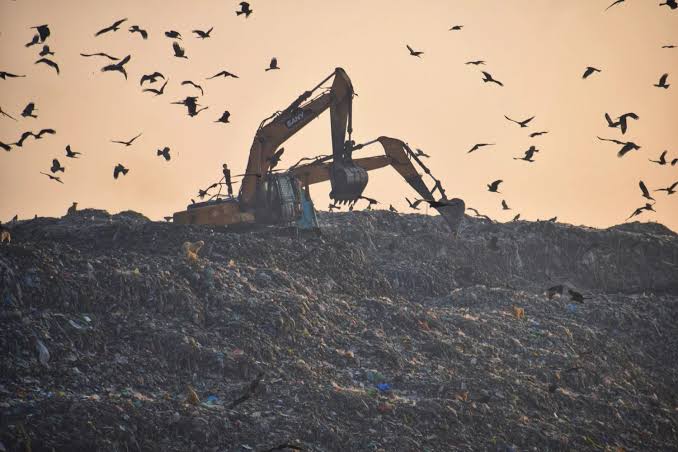
A decades-old wound, the Achan landfill has long been Srinagar’s open wound — a festering reminder of administrative neglect, misplaced priorities, and a lack of scientific waste management. Since joining the group of concerned citizens (GCC), I have treated Achan not as a dumping site but as a public-health emergency. It was never merely about stench or sight; it was about the invisible poison that has silently seeped into our air, soil, and perhaps our DNA.
In my earlier column in Kashmir Pen, “Kashmir’s Chernobyl: Achan Landfill Ignites Healthcare Time Bomb,” and later through young journalist Farzana Nisar’s remarkable piece in “Mongabay India, “The Landfill that Ate a Wetland,” the issue was laid bare before the public conscience. Over the years, I reached out to all who had touched this problem from any angle — the SMC, the Pollution Control Board, engineers like Mrs. Mutahhara Deva and Mr Sami and Er Parvaiz Fazili, who worked on Achan in ERA, environmental scholars like Prof Samiullah of Kashmir University, and the SPM departments of GMC and SKIMS. With support and valuable inputs from from former SMC Administrator Dr Qasba, environmentalists such as Faiz Bakshi of EPG, and guidance from GCC’s seasoned technocrats and bureaucrats, we knocked on every door — from the Chief Minister’s office to the Divisional Commissioner, from the House Committee on Environment chaired by M. Y. Tarigami to Smart City officials. The message was simple: Achan is not a civic nuisance; it is a public-health crisis.
The Hidden Health Toll- Pending scientific confirmation, ias medico felt that the early symptoms of this slow disaster are already visible. Residents living within a two-kilometre radius of the site need to be evaluated for higher rates of respiratory ailments, skin allergies, and possibly cancers and reproductive disorders. The persistent gas-laden odour from decomposing waste is not just unpleasant — it is toxic. Patients admitted at SKIMS Soura—already struggling with illness—are being forced to breathe polluted air day after day, as highlighted in a letter from the Medical Superintendent expressing grave concern. The very institution that should symbolise healing stands within the radius of hazard. The irony is painful: while doctors fight disease inside, toxins float in from outside.
When we proposed measuring air-quality and gas emissions around Achan, we urged adherence to OSHA guidelines, public-safety notifications, and toxicity monitoring. We suggested a population-based epidemiological survey led by the SPM departments of SKIMS ,GMC and Directorate Health services to assess long-term health effects. These were not grand ideas — just basic scientific precautions. Yet months passed, and still no visible activity
What has always baffled me is the disunity within our civil society. While conscientious citizens like Raja Muzaffar Bhat, Faiz Bakshi, Nadeem Qadri, and others have long raised their voices, our efforts often run parallel instead of converging. If our cause and beneficiaries are the same, why let egos or silos weaken the mission? Kashmir’s civil society has shown deep concern but little collaboration. The Achan episode reminds us that fragmented activism can awaken awareness, but only united action can bring change. For once, a spark of hope was lit—if only we sustain it with collective resolve
Now, at last, the SMC has announced a scientifically structured plan. The commitment is ambitious, likely to process 30,000 metric tonnes of waste per month and clear the site’s 11 lakh metric tonnes of accumulated garbage within 30 months. For a city long choked, this is not a small promise — it is a potential turning point. The plan also includes a waste-to-energy component, transforming part of the refuse into usable fuel, while biodegradable waste will become nutrient-rich compost for horticulture and agriculture. Even construction debris is to be recycled for infrastructure projects. If implemented transparently and efficiently, this could turn a decades-old eyesore into a model of urban renewal.
Today the common man, and /or conscious citizen feels re- assured, appreciates and welcomes this initiative wholeheartedly interprets the move as a long-awaited policy recognition of serious environmental and public-health concerns. The acknowledgment that Achan represents a gross violation of people’s fundamental right to breathe fresh air marks a moral shift in governance. As healthcare policy analyst I do appreciate the inclusion of recycling, bioremediation, and waste-to-energy in the new design — signalling that Srinagar may finally join the league of cities adopting circular-economy principles.
Caveats and Cautions- But applause must come with accountability. Past efforts to address Achan have too often been abandoned halfway. Projects started with fanfare, only to sink under inertia, shifting priorities, or lack of technical oversight. The government’s commitment to a 30-month deadline must therefore be accompanied by essential safeguards.
An independent monitoring mechanism should be established, comprising experts from environmental sciences, public health, engineering, and civil society, including bodies like GCC EPG, PEG and activists like Raja Muzaffer and advocate Nadeem Qadiri. Monthly progress reports and air-quality data must be published online to ensure transparency. Journalists, researchers, and citizens should have periodic access to the site, for sunlight is the best disinfectant. Most importantly, the people of Achan, Eidgah, Soura, and adjoining localities should not remain passive spectators. They should participate in awareness campaigns, segregation drives, and local monitoring committees. When citizens become stakeholders, sustainability follows naturally.
Health First, Always- Let us remember: waste management is not only an environmental or municipal issue — it is a health-policy issue. Every bag of unsegregated garbage is a potential breeding ground for disease. Every toxic emission is a silent blow to public health. Therefore, the departments of Health & Medical Education, the Pollution Control Board, SMC, and Urban Development must act in synergy. Achan’s revival should become a cross-departmental mission, not just a municipal project.
One of the biggest casualties of the Achan saga has been public faith, here is a chance to reclaim public trust-. Citizens had grown cynical after decades of unfulfilled promises. Now, if this plan is implemented sincerely, it can restore that faith — showing that government responsiveness and citizen advocacy can work hand in hand. To borrow the words of a local resident, “We just want to breathe without fear.” That, after all, is not a privilege but a right.
Learning from the Past, building for the future- Achan also holds lessons for future urban planning. No city can thrive if waste is treated as an afterthought. Every new township, commercial hub, or housing colony must integrate waste segregation and recycling into its design. Educational institutions should embed environmental responsibility into their civic curriculum. Hospitals, hotels, and industries must adopt zero-waste principles. Srinagar, once known for its pristine air and blue skies, deserves no less than a clean, efficient, and accountable waste-management system.
Major Pick Up Together We Can Do More-The transformation of Achan will test the sincerity of our institutions, the professionalism of our engineers, and the patience of our people. If all three align, Srinagar can become a case study in how public pressure, media vigilance, and government resolve together can reverse environmental decay.
So yes — “deer aayey durust aayey.”- The beginning may be late, but it is welcome. Now, let us ensure it is also lasting. Because this time, Srinagar must truly breathe again.
Disclaimer: The views expressed herein are solely my own and do not represent the official position or policy of any group, society, or forum.
(The author is a Healthcare Policy Analyst and Member of the Civil society groups or concerned citizens (J&K). He writes on healthcare quality, environment, and civic responsibility.)


Comments are closed.