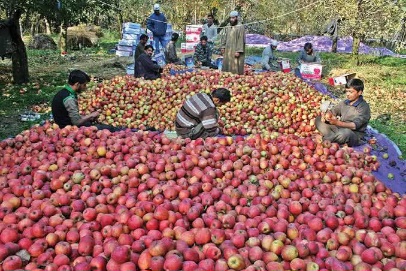
For decades, the story of Kashmir’s horticulture has been the story of the apple. From Sopore to Shopian, from Kupwara to Kulgam, nearly every farmer who moved from paddy to orchards planted apple trees. Today, apples account for roughly 70 percent of Kashmir’s horticultural income and cover nearly 46 percent of the total 3.5 lakh hectares under horticulture in Jammu and Kashmir. Around seven to eight lakh families depend directly on this single fruit, with average yields of 10 to 12 metric tonnes per hectare. It is a proud story of transformation—but also one that hides a growing vulnerability.
When one crop becomes the lifeline of an entire economy, the risks multiply. Apple dependence has created a fragile ecosystem where farmers’ fates hang on uncontrollable variables. Each year, prices fluctuate sharply—from ₹600 to ₹1,200 per box at the farm gate—depending on weather, market demand, and transport conditions. Highway closures, which are common in the Valley, lead to losses estimated between ₹500 and ₹800 crore annually as perishable fruit rots en route to Delhi or Mumbai. A single hailstorm can destroy 30 to 40 percent of the crop in a district. And because middlemen and commission agents outside Kashmir control pricing and logistics, local farmers remain at the mercy of markets they neither see nor influence.
Diversification, therefore, is not a slogan—it is survival. The experience of other states offers valuable lessons. Himachal Pradesh diversified from apples into kiwis and off-season vegetables, creating resilience and higher incomes. Maharashtra’s Talegaon region has emerged as a global floriculture hub. Kerala’s small homestead farmers earn foreign exchange through spices. Why should Kashmir, with its diversity of landscapes and climates, be trapped within the narrow band of apple economics?
Kashmir’s geography and seasons provide immense opportunity. The karewas are ideal for saffron and floriculture. Orchards can inter-crop with plums, pears, and cherries, while the foothills can grow exotic vegetables like lettuce, broccoli, and capsicum under polyhouse systems. Medicinal and aromatic plants—lavender, tulsi, and others—have global demand and can offer sustainable new revenue streams. Lavender oil, for instance, fetches between ₹8,000 and ₹10,000 per litre in export markets. Saffron from Pampore can yield returns of ₹6–8 lakh per hectare with proper care and marketing. Cherries, plums, and pears command 30–40 percent higher farm-gate prices than apples in Indian metros. Even kiwi cultivation, as Himachal has shown, can bring in ₹10–12 lakh per hectare compared to ₹4–6 lakh from apples.
Such diversification can transform Kashmir’s rural economy. If just 20 percent of orchard land—around 70,000 hectares—is diversified into high-value alternate crops over the next five years, additional revenue potential of ₹3,000–4,000 crore could be realized annually. More importantly, this shift would stabilize farm incomes. When one crop fails, others could sustain livelihoods, protecting families from the devastating impact of weather, transport, or market shocks. Diversified horticulture is also more labour-intensive, generating 30–40 percent more rural jobs per hectare than apple cultivation alone. That means more employment for youth, more income in villages, and a stronger, more resilient economy.
What does this transition require? Not just vision, but structure. Farmers will not experiment unless they see market assurance and institutional support. The government must invest in multi-crop cold chains and pack houses every 40 to 60 kilometres to ensure that all horticultural produce—not only apples—can be stored and transported efficiently. Insurance schemes and forward contracts should protect farmers from price collapses and crop failures. Cluster-based farming models must be created to scale up new crops collectively. Export linkages with Gulf and European markets can open new doors for Kashmir’s cherries, kiwis, and flowers.
There are already success stories in the Valley that show what is possible. Lavender cultivation in Budgam has gained traction and can become a profitable venture with proper market linkages. The revival of saffron in Pampore demonstrates that with policy backing, even struggling traditional crops can flourish again. Trout farming in Anantnag and Ganderbal proves that farmers are ready to diversify when they see results and receive institutional support. What is missing is a coherent, Valley-wide strategy that connects these isolated successes into a long-term horticultural vision.
If Kashmir manages to implement this shift, the results could be transformative. Farmers could double their incomes, rural employment could rise substantially, and the Valley could insulate itself from the boom-and-bust cycles of a single fruit economy. Diversification does not mean replacing the apple—it means freeing the farmer from its monopoly. The apple will always remain Kashmir’s pride, but the future must belong to a new generation of farmers who dare to sow differently.
Kashmir’s prosperity cannot rest on one fruit alone. With four distinct seasons, fertile soils, and creative, hardworking farmers, the Valley deserves a basket of crops and a more secure future. The time has come to think beyond apples—to build an economy rooted not in vulnerability, but in variety and vision.
Dr Sanjay Parva is an author, communications strategist, and was a debut contestant from the 28-Beerwah Assembly Constituency in 2024.


Comments are closed.