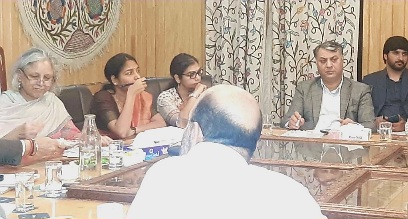
Srinagar: The Kashmir Chamber of Commerce & Industry (KCCI) on Tuesday raised a series of critical issues affecting the handicraft sector of Jammu & Kashmir during an interaction with Neelam Shami Rao, Secretary, Ministry of Textiles, Government of India, held at the Government Arts Emporium here.
The meeting was attended by senior officials of the Ministry of Textiles, Commissioner Secretary Industries and Commerce, Vikramjeet Singh, and Director Handicrafts & Handloom, Musurrat Islam.
KCCI President Javid Ahmad Tenga, while welcoming the GST Council’s decision to reduce GST on handicraft items from 12% to 5%, said the measure reflected Prime Minister Narendra Modi’s vision and would bring relief to artisans. He emphasized that the handicraft sector, with a 600-year-old legacy since the arrival of Shah-e-Hamdan (RA), provides direct livelihood to over 3.8 lakh artisans in Kashmir.
Among the major demands put forth was the establishment of a dedicated warehousing facility for Kashmiri handicrafts at Dubai Mart, a proposal already placed before Union Minister of Commerce & Industry Piyush Goyal. Tenga also underlined the need to facilitate artisan participation in national and international fairs, including Reverse Buyer-Seller Meets, with specific allocations for KCCI members to directly connect with global buyers. He further proposed hosting a Buyer-Seller Meet in Srinagar to promote both handicrafts and tourism, particularly in the wake of the recent downturn following the Pahalgam incident.
Highlighting economic concerns, Tenga called for the reintroduction of a 3% interest subvention on export finance for small exporters and artisan-run businesses. He also pressed for reforms in the ROSCTL scheme, pointing out that the capped benefit of Rs. 438 on woollen and Pashmina shawls undervalues handcrafted products that can range from Rs. 7,000 to Rs. 1 lakh. He urged the removal of such capping and the restoration of FOB-based incentives, as was available under the earlier MEIS scheme.
The KCCI President also urged recognition of North Kashmir as a “Carpet Cluster” for its globally acclaimed silk carpets, while suggesting that other artisan-dense districts be notified as Handicraft Clusters for targeted development. He cited the success of Kanihama village in Budgam as a handloom hub to support his demand.
On the global front, Tenga stressed that Europe and the Middle East remain core markets for Kashmiri handicrafts and sought official support for market study tours and trade delegations. The Secretary of Textiles encouraged KCCI to submit a detailed proposal identifying priority markets for such initiatives.
Concluding the session, Ms. Neelam Shami Rao assured the delegation that the issues raised would be duly considered in future policy planning, reiterating the Ministry’s commitment to safeguarding Kashmiri artisans and expanding the sector’s reach.