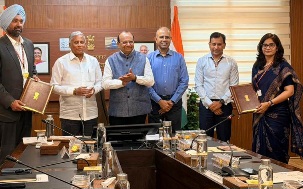
New Delhi, May 6: The Ministry of Jal Shakti on Wednesday signed reform-linked Memorandums of Understanding (MoUs) with Mizoram and Ladakh under Jal Jeevan Mission 2.0, marking a key step towards strengthening sustainable and community-driven rural drinking water delivery systems.
The agreements, signed in the virtual presence of Union Jal Shakti Minister C. R. Patil, commit both regions to a structured reform framework centred on Gram Panchayat-led governance, transparency, and long-term sustainability of water supply systems.
Officials said the reform-linked approach emphasises a shift from infrastructure creation to service delivery, ensuring that every rural household receives adequate and safe drinking water on a regular basis. The initiative aligns with the national goal of “Har Ghar Jal” and the broader vision of Viksit Bharat @2047.
Minister of State for Jal Shakti V. Somanna and senior officials from the Department of Drinking Water and Sanitation (DDWS) were also present during the signing ceremony.
The MoU with Mizoram was signed in the presence of Chief Minister Lalduhoma, who termed the agreement a “game changer” for the state. He highlighted that over 1.33 lakh rural households have already been provided Functional Household Tap Connections (FHTCs), with nearly 99 per cent physical progress achieved. He also pointed to the establishment of 28 water testing laboratories and strong community participation through Village Water and Sanitation Committees (VWSCs).
In Ladakh, the MoU was signed in the presence of Lieutenant Governor Vinai Kumar Saxena, who described the development as a “historic occasion” for the Union Territory. He noted that Ladakh has achieved over 98 per cent FHTC coverage and stressed the importance of community-led verification to ensure accountability in water supply systems.
Addressing the event, Union Minister C. R. Patil said the MoUs would play a pivotal role in achieving universal rural tap water coverage by 2028. He urged both Mizoram and Ladakh to accelerate reforms in operation and maintenance, enhance community participation, and conduct regular District Water and Sanitation Mission meetings.
Patil also emphasised the importance of water conservation initiatives under “Jal Sanchay Jan Bhagidari” and called for convergence with schemes like MGNREGA to ensure long-term sustainability of water infrastructure.
Secretary, DDWS, Ashok K. K. Meena, said the MoUs reflect a shared commitment between the Centre and states/UTs to move towards decentralised, community-managed water systems. He stressed that empowering Gram Panchayats and local committees would be critical in maintaining and operating rural water supply infrastructure effectively.
The Centre reiterated its commitment to supporting both Mizoram and Ladakh through timely fund releases and policy guidance, as part of efforts to ensure safe, secure, and sustainable drinking water access for all rural households.