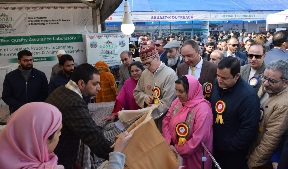
The 3-day Gongul Kisan Mela concluded on Monday at SKUAST-K Shalimar. The event was inaugurated by the Chief Minister Omar Abdullah, accompanied by Agriculture Minister Javid Ahmad Dar, Health and Education Minister Sakeena Itoo and the Vice Chancellor of SKUAST-K Prof Nazir Ahmad Ganai.
The Chief Minister highly appreciated the university’s research contributions and extension work. Under the leadership of the Vice Chancellor, SKUAST-K has achieved remarkable progress. It is the only agricultural university in the region to have generated more than 100 startups and patents. Every year, new and improved crop varieties are developed and provided to farmers, helping them enhance productivity and income. Through its consistent research, innovation and field outreach, the university has played a crucial role in making farmers more self-reliant. The economic condition of farmers has improved significantly and the vision of doubling farmers’ income is increasingly becoming visible on the ground. The dedicated efforts of scientists and scholars are at the heart of this success. The research carried out in laboratories is effectively transferred to the fields through extension services, ensuring that innovation directly benefits the farming community.
Every year, SKUAST-K successfully conducts the Kisan Mela, showcasing new technologies and improved crop varieties for the farming community. However, behind this success stands a tired, struggling and often neglected scholar, whose years of sacrifice, hard work and family compromises make these achievements possible.
A PhD scholar spends nearly 10–11 of the most valuable years of life in education and research, dedicating days and nights inside labs to generate innovations that directly benefit farmers and strengthen the agricultural economy. Ironically, despite contributing to farmer self-reliance and national agricultural progress, these scholars face an uncertain and insecure future after completing their degrees.
After investing more than a decade in specialization, many scholars remain unemployed or underemployed. Society begins to view them as unproductive and they often become financially dependent on their families. Instead of utilizing their advanced research skills in their respective fields, they are forced to divert their careers toward survival-based occupations, starting from zero in areas completely disconnected from their expertise.
Every year, the university produces thousands of graduates and postgraduates in Agriculture, Forestry, Veterinary Sciences, Fisheries, Sericulture, Horticulture and Agricultural Engineering. However, barely 2–3% are absorbed into relevant government departments, while the remaining 97% remain unemployed, underemployed or waiting for opportunities that never materialize.
The situation is especially alarming in Forestry. Despite producing highly trained forestry graduates for decades, not a single major recruitment has been completed through the JKSSB since 2010, even though hundreds of posts were referred in 2010, 2013 and 2021. Furthermore, forestry graduates are often denied priority or exclusive eligibility in forest department posts, while unrelated streams are allowed to apply. This raises a fundamental question of fairness and policy consistency. Just as only specialized graduates are eligible for fields like engineering, medicine, pharmacy or nursing, Forest department should prioritize forestry graduates who have undergone years of dedicated professional training in silviculture, forest Mensuration, forest products utilization, Forest and wildlife management and other related subjects.
We respectfully urge the Hon’ble Chief Minister and Forest Minister to take concrete and immediate steps. Fill al thel pending vacancies in Agriculture, Forest and allied sectors by specalised professional degree holders. Like (JAEO and AEO in Agriculture), Forester and Range officer in Forest Department. Create new posts in line with the growing number of specialized degree holders and technocrats. Ensure subject specific recruitment policies that prioritize domain experts. Provide structured career pathways for highly trained research scholars. Protect the dignity, future and contributions of agricultural and forestry professionals.
We understand that the government cannot provide jobs to everyone, but during a decade i have not seen even 5% Forestry and agriculture graduates have been absorbed. We have dedicated 12 years of our lives, yet we have not even received that small opportunity. Since 2010, there has been a court stay on the Forester posts. If the government truly intended to resolve this issue, it could have amended the recruitment rules much earlier. If these posts fall under Level 5, is it justified to keep the eligibility criteria limited to only 10+2?
Once again, with folded hands, we sincerely request national conference Government to take concrete steps and implement meaningful measures for specialized degree holders. Otherwise, such courses should be discontinued if the Government is not willing to recognize or accommodate them.
The author can be emailed at tanveerr817@gmail.com