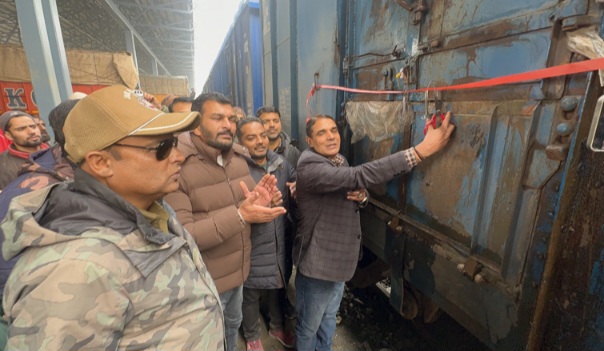
Srinagar, Dec 22 — In a major milestone for rail-based logistics in Jammu & Kashmir, the first-ever Food Corporation of India (FCI) freight train carrying foodgrains reached the Kashmir Valley on Saturday, marking the formal integration of the region with the national freight rail network.
The freight train, carrying around 1,384 tonnes of foodgrains in 21 wagons, arrived at the Anantnag Goods Terminal from Ajitwal Railway Station in Punjab, becoming the first instance of bulk foodgrain transportation by rail directly to South Kashmir.
Lieutenant Governor Manoj Sinha congratulated the Indian Railways on the achievement, calling it a “long-cherished dream” that would significantly ease pressure on National Highway-44, which has traditionally been the Valley’s primary supply route.
In a post on social media platform X, the Lieutenant Governor said the development was a memorable occasion that fulfilled the long-standing aspiration of connecting Kashmir to the national freight network. He noted that year-round freight movement would benefit people, enterprises and infrastructure projects without the risks posed by adverse weather conditions.
According to Lok Bhavan, the LG said rail-based freight transport would ensure smoother logistics and reduce dependence on road transport, particularly during highway closures caused by rain, snow or landslides.
The Lieutenant Governor also expressed gratitude to Prime Minister Narendra Modi and Union Railway Minister Ashwini Vaishnaw for making Jammu and Kashmir’s economic progress an integral part of the country’s broader growth trajectory.
FCI officials described the arrival of the freight train as a landmark achievement, crediting the Central government, the Railways and the Ministry of Food for the initiative. An FCI official said that transporting over 1,300 metric tonnes of foodgrains within a few hours reflected the scale and efficiency of the effort.
“Earlier, due to rains or snowfall, the National Highway would remain closed, creating difficulties in supply. Now distribution will become easier, transportation costs will come down, and a lot of time will be saved. We are no longer worried about road or weather conditions,” the official said.
Officials said rail connectivity would ensure uninterrupted and efficient supply of foodgrains, reduce transportation costs by more than half, and strengthen food security in the Valley.
They also pointed out that the foodgrain consignment builds on earlier successful rail freight operations in Kashmir, including the transportation of cement and automobile consignments, indicating growing reliability of rail freight connectivity.
Authorities said 42 more wagons carrying around 2,600 metric tonnes of foodgrains are expected to arrive in the coming days, further strengthening the supply chain.
The development is expected to boost local markets, support the regional agricultural economy, create employment opportunities and benefit farmers, while ultimately reducing prices for consumers.
Officials said the commissioning of the Anantnag Goods Terminal has opened new avenues for the movement of essential commodities and reinforced Kashmir’s connectivity with the rest of the country through efficient and sustainable rail transport.