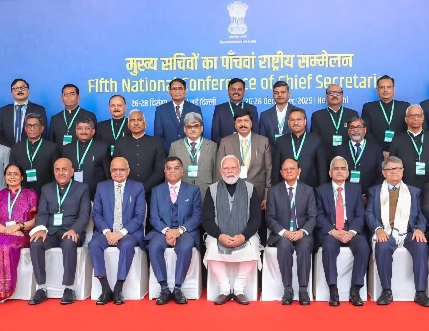
New Delhi: Prime Minister Narendra Modi on Saturday chaired the Fifth National Conference of Chief Secretaries, underlining the need for quality-driven governance, accelerated reforms, and cooperative federalism to realise the vision of a Viksit Bharat. The three-day conference, held in New Delhi from December 26 to 28, brought together Chief Secretaries of all States and Union Territories, senior officials, and domain experts.
J&K was represented by its chief secretary, Atal Dullo.
Addressing the gathering, the Prime Minister said India has boarded the “Reform Express”, powered by its young population, and emphasised that human capital—comprising skills, health and knowledge—will be the cornerstone of the country’s economic and social transformation. He noted that nearly 70 per cent of India’s population is in the working-age group, presenting a historic opportunity to accelerate national growth.
Highlighting the theme of the conference, “Human Capital for Viksit Bharat”, the Prime Minister stressed that quality and excellence must define governance, service delivery and manufacturing. He asserted that the label “Made in India” should become a global symbol of quality, competitiveness and trust.
Calling for stronger self-reliance, the Prime Minister urged States to identify at least 100 products for domestic manufacturing to reduce import dependence and enhance economic resilience. He emphasised that the forthcoming National Manufacturing Mission must be treated as a top priority by all States, with a focus on improving ease of doing business, strengthening infrastructure and attracting global investment.
The Prime Minister also underscored the importance of transitioning towards high-value agriculture, dairy and fisheries to make India a global food basket. He called for a shift from low-value farming to diversified, export-oriented agricultural practices supported by technology and market access.
Highlighting the role of tourism as a growth engine, he urged States to develop at least one world-class tourist destination each, supported by robust infrastructure and local skill development. He also stressed the need to align India’s sports ecosystem with global standards, noting that preparations must begin now if the country is to succeed in hosting major international sporting events in the future.
On governance reforms, the Prime Minister called for enhanced use of technology, data-driven decision-making and artificial intelligence to improve public service delivery. He also stressed the importance of cyber security, digital governance and capacity building of government officials to meet emerging challenges.
The Prime Minister emphasised that States should prepare detailed 10-year development roadmaps with clear milestones for 1, 2, 5 and 10 years, supported by regular monitoring and outcome-based evaluation. He also highlighted the need for coordinated action between the Centre and States, noting that cooperative federalism remains central to achieving national goals.
The conference also focused on themes such as early childhood education, school and higher education reforms, skilling, sports development, heritage preservation, digitisation of manuscripts, and strengthening healthcare and nutrition outcomes. Special sessions examined deregulation, ease of doing business, adoption of technology in governance, and strategies for inclusive and sustainable development.
Concluding his address, the Prime Minister said the conference reflected India’s collective resolve to translate ideas into action. He urged all States and Union Territories to work in unison to ensure that the vision of Viksit Bharat translates into tangible improvements in citizens’ lives, reinforcing India’s journey towards becoming a developed nation.