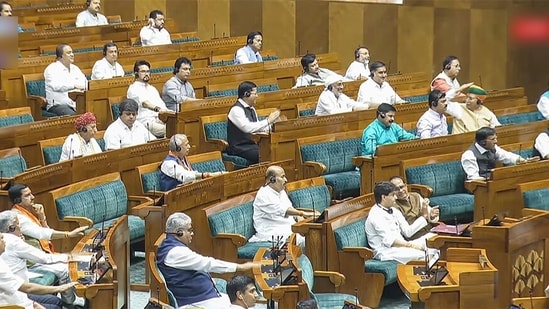
New Delhi: The Ministry of Law and Justice on Friday said that Indian courts are increasingly encountering cases involving morphed and fabricated digital content, prompting stronger legal and procedural safeguards to authenticate electronic evidence. The information was shared by Minister of State for Law and Justice Arjun Ram Meghwal in the Lok Sabha.
According to the Ministry, such cases are being filed under provisions of the Information Technology Act, 2000—including sections on identity theft, personation, and transmission of harmful or obscene material—as well as under the Bharatiya Nyaya Sanhita, 2023, which covers offences related to electronic forgery and falsification of records. The judiciary has acknowledged the rising risks posed by manipulated digital content and its influence on public perception.
To address these challenges, the government has strengthened processes for authenticating electronic records. Section 63 of the Bharatiya Sakshya Adhiniyam, 2023 now mandates authentication certificates for verifying digital evidence submitted in courts.
The Ministry also highlighted advancements under the eCourts Mission Mode Project, under which many court proceedings are now live-streamed, and authentic judgments are published online to enhance transparency. Phase III of the project, with an outlay of ₹7,210 crore, aims to further digitize the judiciary to make justice delivery more accessible, efficient, and reliable.
Of this allocation, ₹53.57 crore has been earmarked for future technologies—including AI and blockchain—to support modernisation. The Supreme Court has constituted an Artificial Intelligence Committee to explore AI’s potential in the judicial system, though no formal policy has yet been adopted. AI tools remain restricted to controlled pilot use within the approved scope of the eCourts DPR.
The judiciary is also assessing challenges associated with AI integration, including concerns over algorithmic bias, translation accuracy, data privacy, and the need for manual validation of AI-generated outputs. A sub-committee of six High Court judges and technical experts has been formed to examine secure connectivity and authentication mechanisms and review digital infrastructure.
Two AI-based tools are currently in pilot use: the Legal Research Analysis Assistant (LegRAA), designed to support legal research and document examination, and Digital Courts 2.1, a platform offering judges streamlined access to case information. Digital Courts 2.1 includes voice-to-text and translation features to aid in dictation and drafting. The Supreme Court’s eCommittee has reported no systemic bias or unintended outputs from these tools so far.


Comments are closed.