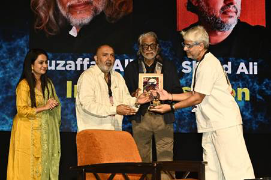
Mumbai: At the 56th International Film Festival of India (IFFI) in Goa, the stage transformed into a space where memories, craft and generational legacies converged. In a rare public conversation, filmmaker Muzaffar Ali and his son, director Shaad Ali, opened a window into two eras of Indian cinema—one shaped by poetry and displacement, the other by reinvention and emotional restoration.
Moderated with affectionate curiosity by Shaad, the session began with a simple question: What did young Muzaffar dream of becoming?
The answer unfolded like a soft montage—childhood drawings, art competitions, and the quiet pull of poetry. Cinema, Muzaffar Ali recalled, entered his life later, as a space of emotional release and imaginative freedom. “Filmmaking is about what your chemistry, botany, geology is,” he said, hinting at the deeply personal world that shaped his art.
It was this inner world—and his early encounters with migrant suffering—that shaped Gaman, his acclaimed film about displacement. Even after winning the Silver Peacock at IFFI, Muzaffar said the award never made him feel elevated. Success, he said, only reminded him of the struggles ahead.
Shaad steered the conversation to the craft that defined his father’s early work. Muzaffar spoke of remaining rooted—visually, musically, culturally. The timeless music of Umrao Jaan, he explained, was born from poetry, surrender and collaboration. “Poetry makes you dream, and the poet must dream with us,” he said.
But one of the most emotional moments came with the discussion of Zooni, Muzaffar Ali’s ambitious, unfinished film set in Kashmir. What began as a dream bilingual project ultimately collapsed under logistical and seasonal challenges. Calling it “a dream beyond many dreams,” Muzaffar reflected on its heartbreak—but also on its undying spirit. Kashmir, he insisted, is not merely a backdrop but a living culture. “Films for Kashmir must be born in Kashmir,” he said, urging local artists to tell their own stories.
Shaad revealed that he is now immersed in restoring Zooni, working with old negatives and soundtracks to revive a cinematic vision that never reached the screen. A touching video, Zooni: Lost and Found, captured this emotional journey of rediscovery, bridging two generations through an unfinished dream.
During the audience Q&A, a question surfaced on why films don’t fully reflect Kashmir’s real culture. Muzaffar responded with conviction: Zooni, he said, was designed precisely for that purpose—and that Kashmir already possesses everything needed to bring its own stories alive.
By the session’s end, it felt less like a conversation and more like witnessing a cinematic inheritance being passed on—one defined not just by craft, but by dreams, wounds, discoveries, and a shared hope for the future.