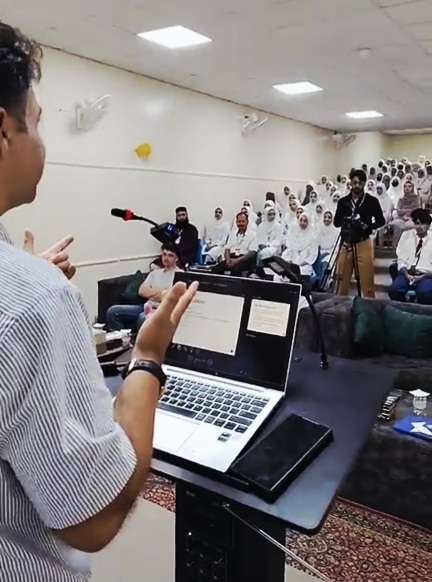
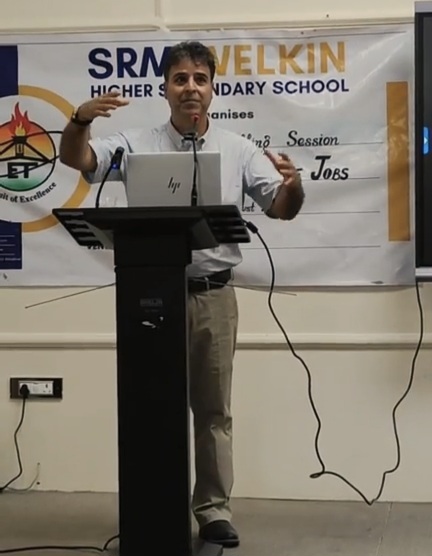
Following is an abridged version of the lecture delivered by Arjimand Hussain (founder of Ziraat Times) at the Welkin Institute Sopore on August 5, 2025
Assalamu Alaikum, Adaab and a very good morning to all of you.
Let me begin by saying what a real privilege it is to be here with you today, among some of the brightest young minds of north Kashmir. We are at a very special place today. You may not fully appreciate that, but I wish to tell you how I see this institution from a distance – an institution of excellence, which has many firsts to its credit.
I would like to begin by offering my heartfelt respect to Ms. Baseema Inayat, the founder and visionary behind this extraordinary place. In an age where most people prefer the comfort of staying back in metropolitan cities or even abroad after finishing their education, she chose a different path — a much more difficult, but meaningful one. She returned home, to your lovely place of Sopore and built something that not only educates over 5,500 students, but also provides employment to a large number of men and women, helping build families, careers and, above all, hope.
I am sorry I would not be able to deliver this talk in Kashmiri – our mother tongue – today because we are going to use a lot of technical jargon in this conversation. However, normally, we all must speak in and encourage talking in Kashmiri. That is our identity.
Today, I want to speak with you about your future. I would try to speak in a language that would resonate with you, that you would not find boring and a language that you would enjoy and, finally, make some use of. I will not talk theory, or what all you may already be knowing. Instead, I would be drawing mostly from my personal experiences and insights acquired from interactions and observations across the world.
Some weeks ago, during a chat, my 8-year-old son said to me – “that matter is sus”. I asked him to repeat because I couldn’t understand him. He repeated the same. I was a little confused and told him I hadn’t heard that word “sus”. He looked surprised and wondered how I didn’t know sus meant suspicious!!
During an interaction with a group of youngsters recently, I heard two more terms – “NPC energy” and “delulu”. I was honestly clueless what those terms meant. And after some inquiries I got to know that your generation today call your somewhat passive, lazy mates as “NPC energy”, and “delulu” to you is being delusional !!
In our Gen Y, NPC types were referred to as “tubelights”, and I am sure you wouldn’t know this slang.
What I mean to say is that all generations have their own languages of communication. And it is important for our generations to know each other’s language to better understand each other’s worlds, aspirations, fears and ways of looking at the future. And let me assure you that despite being from a different generation, I will listen to you and promise that I will try my best to understand your language and aspirations in this conversation. So let us begin with hearing from you what your expectations from this conversation are.
Today, as you know, we are standing on the edge of one of the greatest transitions in the history of work and human productivity.
According to the World Economic Forum’s Future of Jobs Report 2025, by the time many of you enter the workforce – whether in five, seven, or ten years – around 63% of students like you will be working in jobs that don’t even exist today. Let me repeat that: the majority of you will find yourselves in careers that have not yet been invented. The tools, skills, and industries that will shape your professional life are still emerging, and all this is happening at a very rapid speed.
Now, this may sound exciting to some of you, and overwhelming to others. And that’s completely normal. We are moving into a world where artificial intelligence, big data, automation, green energy, and digital transformation would even define the kind of jobs we have in J&K and the rest of the country. And it is not something distant. All this would impact us.
I don’t want to sound alarmist but it is important to jolt you a little bit – for your parents or teachers, the professional world was relatively predictable. For you, it’s going to be unpredictable — but full of possibilities, both opportunities and challenges.
The first major shift we must understand is the green transition. As climate change becomes the most pressing issue of our times, governments and businesses around the world are investing massively in renewable energy, electric vehicles, waste recycling, biodiversity conservation and climate-smart agriculture. This transition is creating millions of new green jobs — jobs that didn’t exist a decade ago. Roles like solar panel designers, energy auditors, climate risk analysts and carbon accountants are already in high demand. And this is just the beginning.
The second shift is artificial intelligence and automation. You’ve probably already used ChatGPT or heard about robots taking over tasks in banks, hospitals, factories and even classrooms. AI will certainly replace many routine, repetitive jobs — things like data entry, cashier roles, and basic clerical work. We all see that already happening in the banks we visit or the government and private offices we go to. But that’s not the full picture. The deeper truth is this: AI will not replace humans — but people who use AI will replace those who don’t.
So you are standing at a time when you must embrace technology, not fear it. Just like our generation did it – in transitioning from a post office, manual work era to Apps and artificial intelligence based era. The key difference is that the rate of change in our era was slower. The rate of change in your lives is mind boggling. And it is only the beginning.
Let us see it from a historical perspective. It took millenia for human civilisation to transition from the ages of hunting, fire, iron, wheel, basic agriculture to the industrial revolution. And it has taken less than a century from the industrial revolution to this age of super intelligence of computer systems. So imagine the time you are in!
The fact of the matter is that the best future professionals will be those who know how to collaborate with machines — using them for productivity while contributing creativity, ethics and human judgment.
Now let’s talk about something equally important — what does all these changes mean to your Gen Z and Gen Alpha socially and psychologically.
You’ve grown up surrounded by technology, social media, apps and devices. This gives you a unique advantage. You can learn, create and connect at lightning speed. But this advantage has come with immense challenges too.
Digital overstimulation is reducing attention spans. Many teenagers today struggle with anxiety, identity confusion and loneliness, despite being online all the time. There’s also a growing concern that AI-induced insecurity is making young people question their own value — their uniqueness and their place in a world increasingly run by algorithms.
But let me tell you something important: no machine can replace your compassion, your values, your dreams, your ability to care for someone, or to build something with love. These are the qualities that define us as human beings. This is what we call human ingenuity — the creative, intelligent, problem-solving spirit that has helped our species survive and thrive through every major challenge in history.
And when the Holy Quran refers to human beings as Ashraful Makhlooqat (best of all His creations), it is for a big reason. The reason being that humans are able to find solutions and overcome the challenges that come their way.
Think about it: we overcame smallpox, deadly famines, world wars and even pandemics, the latest being the Covid19 pandemic. In the middle of the Covid pandemic we feel it was all over for human civilisation? It did feel that way. But humans used their ingenuity, with technology, determination and collaboration. We innovated, adapted and reimagined the way we live. The same spirit will carry us through today’s big transitions — as long as we stay aware, engaged and emotionally intelligent.
For your generation it will not only be your Intelligence Quotient (IQ) that would define how successful you would be negotiating this change. What would be of immense importance would be your EQ – your emotional intelligence. And when we speak of EQ, let’s talk about soft skills, something that’s becoming more important than ever.
The World Economic Forum says the most valued skills by 2025 will include analytical thinking, creativity, adaptability, resilience and emotional intelligence. These are not taught in textbooks. They are built through experiences, failures, conversations, projects and self-awareness. They are what employers will look for, whether you’re applying for a job or pitching your startup to investors. And trust me that is what employers like us look for. We very rarely actually look at job applicants degree certificates.
Which brings me to something I am personally passionate about — entrepreneurship. I know some of you dream of being independent — of building your own ventures. Perhaps you want to start a tech startup, an e-commerce business, a clean energy initiative, or a local enterprise that solves a social problem. If that’s you — I want to tell you: don’t hold back. The future is wide open for people who are brave enough to create their own path. Yes, there are risks. Yes, there will be failures. But if your idea is rooted in purpose, and you are willing to learn from each step — success is absolutely within your reach.
India, as you may know, is becoming the world’s most populous country and will soon have the largest working-age population. In fact, one in five global workers will be Indian by 2030. That gives you a global advantage — but also a responsibility. Right now, only one in four Indian youth is considered job-ready. That means we need to work harder to bridge the gap between classroom education and real-world skills. The good news is, you can do this. Learn how to learn. Stay curious. Get involved in real-world problems.
Do story the Future of Jobs report of the World Economic Forum. J&K missed the IT Revolution bus, even as we could have contributed immensely. But we must not miss the bus of the green transition and artificial intelligence. When we study the future of jobs report, we learn that 170 million jobs are expected to be created in the next 5 years, in comparison to the 92 million jobs likely to be displaced. That means a net gain of +78 million jobs by 2030. So, you should be optimists and not pessimists.
Yes there is disruption in the job market but there are immense opportunities as well. In that what will be important is whether you are able to acquire global citizenship skills.
Have you heard of those skills?
Global citizenship skills are essential for job aspirants in today’s interconnected world. These include cultural awareness, adaptability and collaboration across diverse teams, enabling individuals to work effectively in international and multicultural environments. Employers today seek candidates who demonstrate empathy, respect for diversity and proficiency in several languages. Being a global citizen means thinking beyond borders, embracing inclusivity and contributing positively to both local and global communities.
To help you find direction, I want to share a beautiful Japanese concept with you — it’s called Ikigai. It means “your reason for being.” It lies at the intersection of four things: what you love doing, what you’re good at, what the world needs, and what you can be paid for. If you can find that sweet spot — that Ikigai — your career will never be just a job. It will be a life of purpose and joy. And do study this concept, it will be very useful to you to set your direction in life.
Now, how do you begin from where you are?
Start by being more aware of the world. Read news about AI, climate change and innovation. Try learning a digital skill — whether it’s Excel, MS Word, coding, or basic data analysis. Join a school project that addresses a community need. Speak up. Fail. Reflect. And grow. You don’t need to wait until graduation to be a change-maker. You can start now, with what you have.
In the end, I want you to ask yourself not just, “What job will I get?” but “What problem will I solve?”. Because the future belongs not to the most qualified — but to the most aware, the most agile and the most compassionate.
Let me close with this thought: At the end of the day, what will really matter is not how many degrees you collect, or how many titles you achieve — but how happy you are, how meaningful your work feels, and what positive contribution you make to the world.
So be courageous. Be curious. And above all, be ready to create the future, not just wait for it to arrive.
Thank you very much. I look forward to hearing your thoughts, your questions — and your dreams.


Comments are closed.