Srinagar — In a stark reminder that climate extremes are no longer distant threats, Kashmir’s temperate ecosystem is showing visible signs of stress in 2025, echoing alarming patterns seen across Europe and other high-latitude regions this summer.
Across the Valley, prolonged heat and dry spells have caused unusual damage: in the rain-fed karewa plateaus, apple and almond trees have dried up entirely; in lower altitudes, including Srinagar, several pine trees have withered — a rare sight in the region’s humid temperate zones. Local horticulturists and foresters warn that even hardy species are struggling under extended periods of high temperature and moisture stress.
“This is not a normal dry summer,” said a senior horticulture officer in Pulwama. “When deep-rooted species like pine start drying in city altitudes, it means the baseline climate has shifted.”
The situation mirrors troubling scenes in Europe, where record heat has broken long-standing temperature marks. In France’s south-west, towns such as Bordeaux and Saint-Émilion saw highs up to 12°C above historical norms. Croatia recorded nearly 40°C in coastal Šibenik and Dubrovnik, while Hungary hit 39.9°C, triggering forest fires across the Balkans. Even the Arctic Circle, normally buffered from heat extremes, endured unprecedented temperatures above 30°C this month.
Scientists point out that Kashmir shares climatic characteristics with parts of southern Europe — both being traditionally temperate fruit-growing regions — meaning that prolonged heat could destabilize centuries-old horticultural systems.
“In Europe, 40% of weather stations in some areas crossed the 40°C mark this week. In Kashmir, the numbers aren’t as high, but the duration and dryness are the killers,” said a climate scientist at SKUAST-K. “Fruit trees and forests here evolved for moderate summers, not months of unrelenting heat.”
Globally, the heatwave is accompanied by devastating wildfires in southern Europe, North America, and West Asia. In Italy and Spain, extreme heat has claimed lives, while in Iraq, temperatures above 50°C caused a nationwide power blackout. The World Meteorological Organization has warned of “extreme to very extreme” fire risks across the Mediterranean basin and parts of central Asia, including Himalayan foothill states.
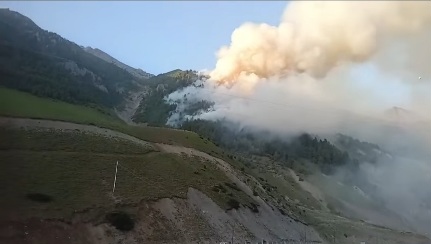
Kashmir’s current season is particularly worrying for farmers. Rain-fed apple orchards have seen premature leaf fall, affecting photosynthesis and fruit quality. Drought stress also raises vulnerability to pest infestations. Forestry experts caution that dry pines increase wildfire risk in a region historically spared from large-scale forest fires.
“This is what climate change looks like, and it will only get worse,” said Bob Ward, policy director at the Grantham Research Institute, echoing global concerns. “Without urgent adaptation and mitigation, temperate zones like Kashmir could face an existential agricultural crisis.”
For locals, the change feels both sudden and irreversible. “We used to pray for sunny days during harvest,” said Ghulam Ahmad, a farmer in Budgam’s karewas. “Now we pray for rain — not floods, just enough to keep the trees alive.”


Comments are closed.