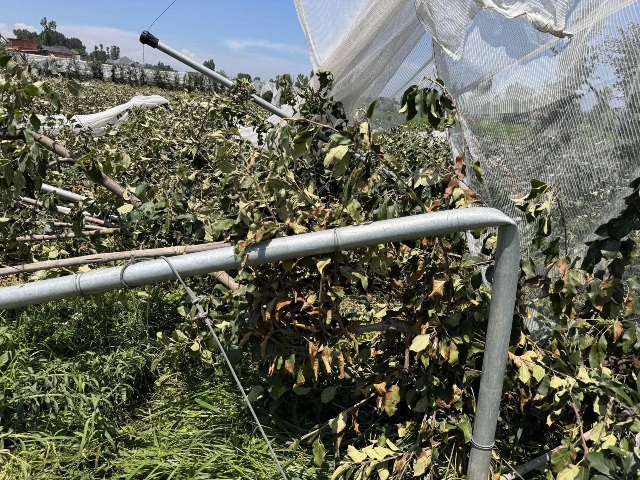
Anantnag — In the heart of Kashmir’s apple season, a mild gust of wind flattened an entire high-density orchard in Mirdanter village, Anantnag, raising serious questions over the structural integrity of trellis systems used in the valley’s booming high-density horticulture sector.
The eight-kanal orchard, established in 2019 by grower Bhat sahab through a private developer, had been showcased as a model of high-density apple cultivation. But recently, its galvanised iron (GI) trellis system gave way under moderate weather, bringing down rows of fruit-laden trees just days before harvest.
“The trellis was too weak to withstand even moderate weather,” Bhat said, pointing to twisted pipes and bruised apples strewn across the orchard floor.
“If proper material and engineering had been used, this wouldn’t have happened. I’ve lost a year’s worth of work, and recovery will take years.”
Preliminary findings suggest that substandard GI trellis systems are becoming common across Kashmir, with some installations using under-specification pipes less than 1.5 millimetres thick and weighing under 10 kilograms — a far cry from the heavy-grade materials mandated by Indian Standard (IS) 1239. Experts say only Class C heavy-grade GI pipes with a thickness of at least 4 millimetres and 250 GSM zinc coating, or prestressed concrete poles, can ensure durability.
The problem is compounded by poor structural engineering during installation.
Key elements such as layout design, proper anchoring, and cable tensioning are often neglected. In some cases, hailnet systems, intended to shield crops from damage, are installed without proper wind load assessments, further straining weak trellis frames.
A senior horticulture engineer warned that while orchards are designed to last 40–50 years, poorly built systems can collapse in less than five, causing massive financial losses for growers and eroding confidence in high-density farming.
With many farmers lacking technical knowledge, they often rely entirely on contractors — some of whom cut costs by using cheaper, lighter materials or omitting critical components. Industry voices are urging farmer training, strict regulation and quality checks to prevent further losses.
Standing over the wreckage of his orchard, the orchardist summed up the growing anxiety in the valley’s apple heartland: “This is not just my loss. If this continues, it will be the loss of our entire apple industry.”