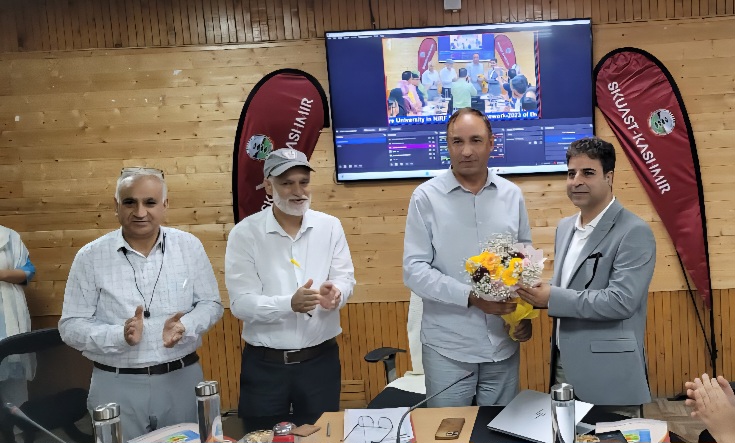
Following is the abridged transcript of Arjimand Hussain’s Lecture on “The Green Transition and the Future of Jobs” delivered at SKUAST Kashmir, July 24, 2025. Full video of the lecture will be available online later.
Good morning everyone,
Vice Chancellor Dr. Nazir Ahmad Ganaie, Dr Sajad Gangoo, Dean Students Welfare other distinguished members of the faculty, students of SKUAST, and my dear young friends — thank you for having me here.
I want to extend my gratitude to Prof Nazir Ahmad Ganaie sahab for this invitation. It’s an honour and a privilege to be with you today in a place that not only represents academic excellence but also carries the spirit of Kashmir’s rich agricultural heritage and future aspirations.
What I wish to talk about today is something very close to my heart — something that affects each one of you more than you probably realize: the Green Transition and the future of jobs. But before I go into the core of my message, let me ask you — how are the young really feeling today?
In my work across 17 countries — from Africa to the Middle East, from Asia to Europe — I’ve had the opportunity to interact with young people from very different backgrounds. While contexts vary, one trend is constant: a deep undercurrent of uncertainty. In Europe and North America, young people are worried about job markets where opportunities exist but well-paying jobs are shrinking and living costs are rising. In Asia-Pacific and China, there’s excitement but also dissatisfaction with how the systems respond to youth needs. In Africa, a youth bulge is pushing against a wall of limited economic opportunities. In the Middle East and North Africa, where I currently work, there’s intense competition, innovation, but also disillusionment.
India, and particularly Jammu & Kashmir, stands at a very interesting crossroad. On one hand, you have a young population with extraordinary potential. On the other, we have structural gaps — limited job diversity, a heavy dependence on the public sector, and a slow transition into future-ready sectors like renewables, data science, and sustainable agriculture.
The worries are real. We are in an age of economic protectionism, geopolitical instability, AI disruption, receding globalization, and the climate crisis. But at the same time, we’re also witnessing something powerful — a shift that may just redefine our future for the better — and that is the Green Transition.
Let’s step back for a moment. Think of the change our generation has seen. I began my career in the telephone era — landlines, hardcopy memos, manually prepared reports. Today, I’m working with AI tools that schedule meetings, analyse data, generate reports, and sometimes even write full proposals. The speed of change is breathtaking.
Globally, between 2005 and 2025, an estimated 85 to 100 million jobs have been lost or transformed. In India alone, the figure is around 12 to 15 million. The most affected sectors include clerical jobs, small retail, public sector support roles, transport, and even photo labs and print media. Even the once-reliable BPO sector is expected to lose up to 1.8 million jobs in India by 2030, as automation and AI take over low-skill tasks.
But let me be clear — this isn’t just about job loss. This is about transformation. Jobs are not just vanishing; they are evolving. And the biggest catalyst of this transformation is the Green Transition.
So what is this transition?
It is the global shift away from fossil-fuel-based economies to a model that is sustainable, low-carbon, and environmentally resilient. It’s about solar panels replacing coal plants, electric vehicles replacing petrol engines, sustainable farming replacing chemical-intensive agriculture, and green buildings replacing concrete monsters that eat up energy.
In India, the implications are huge. We are talking about decarbonizing our industries, moving our power grid toward solar and wind energy, electrifying our transport sector, reducing overuse of fertilizers, and protecting forests and wetlands. All of this means new industries and new jobs.
You may ask: why is India doing this? The reasons are layered.
Firstly, because we are part of international agreements — like the Paris Agreement — that bind us to reduce carbon emissions and report progress. Secondly, because global trade is changing. Europe, for instance, is bringing in the Carbon Border Adjustment Mechanism (CBAM), which means that Indian exports to Europe — like steel and cement — will face carbon taxes if we don’t green our industries. Thirdly, global investors are changing. Green investments now dominate the capital markets. If Indian companies or the government want to raise funds abroad, they must show strong environmental, social, and governance (ESG) credentials.
This means one thing: we need a workforce that is future-ready. And that includes all of you sitting here.
Let me talk about jobs of the future. Think about agriculture. With climate variability, pests, water scarcity, and land disputes, traditional agriculture is becoming unpredictable. But it’s also becoming high-tech. In advanced countries, farmers now use drones, soil health sensors, weather intelligence systems, and AI-based crop monitoring tools. Jobs like climate risk analysts, agriculture supply chain managers, and drone operators are emerging. Even here in Kashmir, this transition is inevitable.
In the energy sector, we’re seeing jobs like renewable energy project managers, energy transition analysts, and compliance officers. In trade and logistics, new roles like supply chain risk managers and geopolitical risk consultants are being created to deal with global uncertainty and changing trade rules.
Even in retail and manufacturing — fraud risk analysts, sustainability compliance officers, and brand reputation experts are now essential hires.
And here’s the big twist: soft skills are now more important than ever. Emotional intelligence, adaptability, conflict resolution, and intercultural communication are crucial in a world that is more interconnected and diverse than ever before. In my own career, I’ve worked with multicultural teams — sometimes with people from 10 different countries on the same project. Success didn’t come from knowledge alone. It came from listening, understanding, and adapting.
Let me now leave you with a few key takeaways based on the latest global reports:
By 2030, 22% of current jobs will either disappear or evolve. The only insurance you have is continuous upskilling.
Skill gaps are the number one concern for global employers. Degrees are not enough. You need application-based skills.
Agriculture is becoming smarter and more digital. If you don’t adopt these technologies, others will.
By 2030, one-third of work globally will be done through human-AI collaboration. Don’t fear AI — learn to work with it.
Globally, the World Economic Forum projects that about 69 million new jobs will be created in green economy sectors, care services, digital trade, and AI. India stands to benefit — but only if our workforce is ready.
In this pursuit, find your Ikigai — your purpose, where your skills meet the world’s needs. That’s where your most meaningful and fulfilling work will lie.
So, dear students of SKUAST, the future is not about simply aiming for government jobs or waiting for vacancies. It is about becoming job creators, innovators, and resilient professionals who can adapt to change. It is about thinking global but acting local. It is about seeing climate change not just as a threat, but as an opportunity to transform how we live and work.
I encourage you to learn beyond your curriculum. Take online courses, build portfolios, work on small projects. Volunteer. Travel. Observe. Most of all — keep asking questions. That is how transformation begins.
Thank you again for the warm welcome. It has been a pleasure to be with you. I leave here hopeful — because looking at you, I see not just the future of Kashmir, but the custodians of a greener, smarter, and more inclusive world.


Comments are closed.