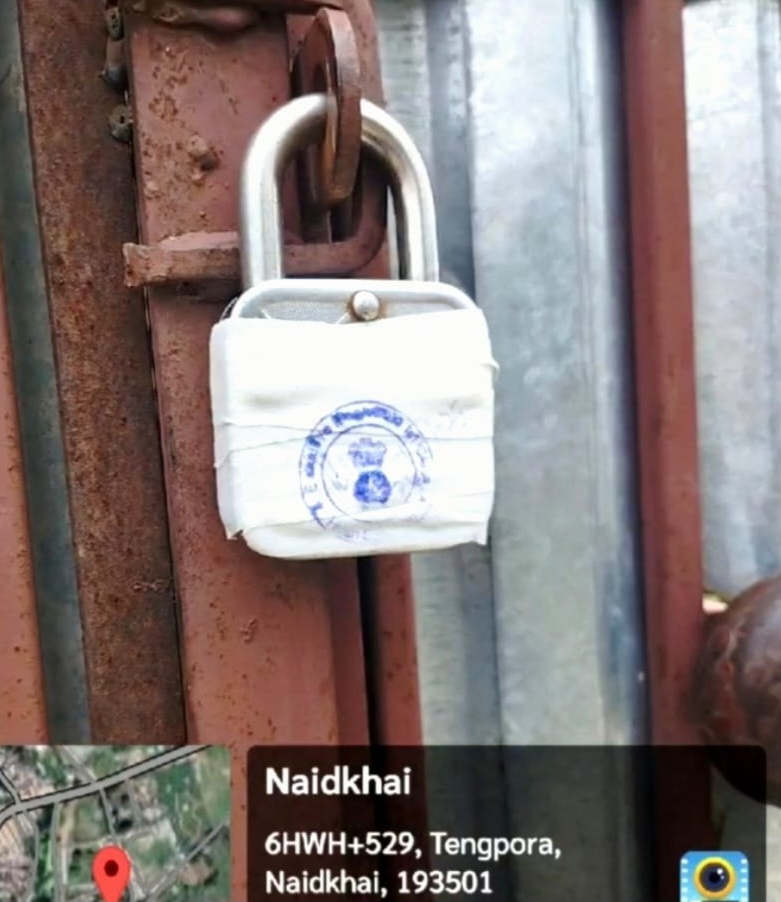
Bandipora: After months of legal and bureaucratic wrangling, the District Administration Bandipora has finally sealed a cement hollow brick manufacturing unit in Naidkhai, following an order by the National Green Tribunal (NGT). The unit had been operating in violation of environmental laws and despite a closure order issued by the Jammu & Kashmir Pollution Control Committee (JKPCC) in May 2024.
The development comes after a prolonged battle led by local resident Zahoor Ahmad Dar, who alleged that the unit was causing significant environmental damage and was located dangerously close to a government higher secondary school and private residences. “We had lost faith in the system, but we are grateful to the judiciary, especially the NGT and JKPCC, for finally coming to our rescue,” said Zahid Ahmad, son of the petitioner.
Despite repeated pleas to the local administration, including the Tehsildar, SDM Sumbal, and Deputy Commissioner Bandipora, no substantial action was taken against the unit. The school principal had formally raised the issue in 2022, triggering a chain of communications between the Tehsildar and Naib Tehsildar. However, the matter was allowed to linger, forcing the complainants to approach the Governor’s Grievance Cell.
In response, the JKPCC investigated and issued a closure order on 27 May 2024, citing violations of the Water Pollution Act (1974) and Air Pollution Act (1981). However, the brick unit’s owner approached the Chief Judicial Magistrate (CJM), Srinagar, and secured a stay order on 28 October 2024.
Legal experts and activists raised concerns about the CJM’s jurisdiction in the matter, as cases under the Water and Air Acts fall exclusively under the purview of specialized environmental forums like the NGT. Nonetheless, the JKPCC, surprisingly, did not challenge the CJM’s stay order in any higher court or tribunal, allowing the illegal unit to continue operations.
Exhausting all administrative channels, Zahoor Ahmad Dar finally approached the Principal Bench of the National Green Tribunal in New Delhi, which took up the matter on 21 January 2025. The Bench, led by Justice Prakash Srivastava (Chairperson) and Dr. Afroz Ahmad (Expert Member), unequivocally stated that the CJM had no jurisdiction over matters governed by the Water Act.
“We find that the order dated 27.05.2024 was passed by the Member Secretary, J&KPCC under Section 33A of the Water (Prevention and Control of Pollution) Act, 1974, and Section 58 of the Act creates a jurisdictional bar on civil courts,” the NGT ruled, advising JKPCC to inform the CJM accordingly.
Following NGT’s directive, the matter returned to the CJM Court in Srinagar. On 15 July 2025, Chief Judicial Magistrate Aadil Mushtaq Ahmad vacated the earlier interim order that had restrained JKPCC from implementing the closure.
“Falling in line with the authoritative judgment supra, I need not determine other requisites, when the very first is missing. The application for interim relief is devoid of any merit and is accordingly rejected,” the order read.
Final Administrative Action
Following the court’s decision, the JKPCC wrote to the Deputy Commissioner Bandipora on 17 July 2025, prompting swift administrative action. On 22 July 2025, the Additional Deputy Commissioner Bandipora directed the Tehsildar Hajin to close the cement hollow brick unit. The unit was subsequently sealed by the district authorities.
“This was otherwise a very petty issue. The DC, SDM, or even the Tehsildar could have closed down this unit much earlier, which was operating near a government school and residential houses,” Zahid Ahmad remarked. “Instead, we were made to move from pillar to post.”
The case has once again highlighted the gaps in local environmental enforcement and the need for timely intervention by administrative authorities. Residents have called on the J&K government to establish clearer mechanisms for the enforcement of environmental laws and to prevent future cases from languishing in bureaucratic limbo.
While the issue may appear minor in scale, it underscores the importance of judicial oversight in environmental governance. The NGT’s involvement not only brought resolution to a long-standing grievance but also reaffirmed its role as the primary forum for adjudicating cases under environmental laws in India.
Local civil society members and environmental activists hope this case sets a precedent for faster redressal of environmental complaints and greater accountability among local authorities.