

By Mudabbir Ahmad Tak (Ph.D)
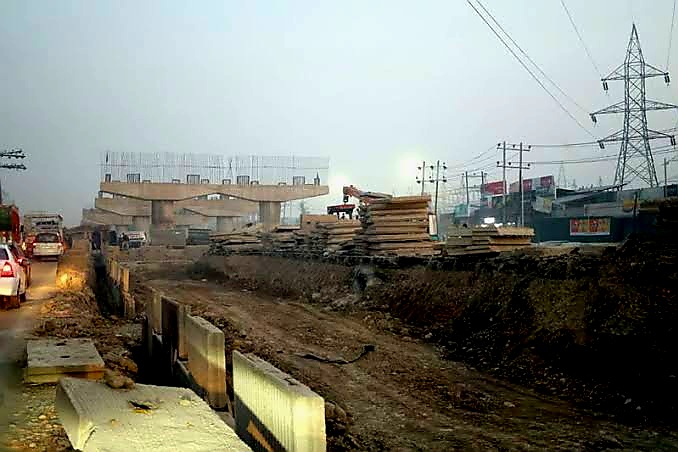
I read the report in your newspaper about the delay in the completion of the flyover at Sanat Nagar. I did not think much of it, because me and several other common people like me who travel along this route every day have mocked and complained about the engineers involved in the construction of this flyover so much, that there is no more mockery and complaining to be done. Or at least I thought so.
Reading your story about the flyover, I began wondering why no reporter had stressed on the surveying aspect of the flyover. There have been other reports about the delay in the completion of the flyover, but all of them have been meek rebukes. The absolutely atrocious mockery that this flyover has become deserves stronger language, and forceful reporting by our media.
What made me write this piece are the responses that your newspaper has received from a couple of engineers that were published in Ziraat Times after the original story had been published. One was titled ‘Rejoinder to Sanat Nagar flyover story: In defence of engineering integrity’ and the other was ‘Sanat Nagar Flyover report by Ziraat Times has missed other details’. As I read these responses, I felt a renewed surge of emotions that refreshed my appetite for mocking and complaining about the engineers and other staff associated with the construction of this flyover. This is a response to those responses.
First, the article titled ‘Sanat Nagar Flyover report by Ziraat Times has missed other details’. I agree with the author, who, as the byline suggests, is an engineer himself, that the article has missed some details- the reporters should have written about the timeline of the flyover- when it was approved (in 2018) and when it was expected to be completed (in April, 2025). That is a total of 7 years for a flyover that has a total length of around 3 kilometres.
But the author of this response first points out the mistake in describing the voltage capacity of the transmission line in question- that it is a 132 kV line, and not 32 kV, as had been described in the original draft of the story. But I contend that even if the transmission line was of the smallest denomination that a transmission line can possibly be, the point of the story and the blunder that these engineers committed cannot be overlooked. The voltage capacity of the line does not change the fact that the engineers and surveyors should have done one of the simplest things that an engineer and a surveyor can do at the time of surveying a site- look up to see if there were any obstacles.
Then, the author says that the “transmission line is not a hindrance to the ongoing flyover work.” One sentence later, the author says, “If required, the Power Development Department is fully prepared to undertake the destringing or dismantling of the said transmission line to facilitate the project.” I wonder, why would this be required if the transmission line is not a hindrance?
Again, only one paragraph and a total of 98 words later, the author says that “out of the three required transmission towers, land for two towers has not yet been acquired by the R&B/Revenue authorities. Despite this, PDD has proactively started the construction of tower foundations by engaging directly with landowners on a personal level to avoid further delay.” If the lines are not a hindrance, why are the said departments working on constructing tower foundations, and why is there talk of acquiring (that is, buying, with taxpayer money) land by these departments? If there is no hindrance, as the author has claimed, why is more taxpayer money being spent? And why is something being constructed “proactively”? Has PDD become clairvoyant all of a sudden?
The author should decide whether the lines are not a hindrance (in which case, they need not be moved), or if they are (hence the buying of land and the tower construction).
And what is proactive about all this? The transmission lines should have been taken into consideration before the road at Sanat Nagar was dug up and thousands of people put through misery since construction began so many years ago. There is nothing proactive about realizing that there is a transmission line right above the flyover, and then beginning the construction of new transmission towers years later.
Also, I would humbly like to know what the author means when he says that the PDD is “engaging directly with landowners on a personal level”. Government departments do not function on a “personal” level. These departments run on taxpayer money, which common people like me and the others pay on time. After paying our taxes, we expect that works such as the Sanat Nagar flyover are completed on time. PDD does not have a “personal” purse from which they can spend money and then be sanctimonious.
The author also puts the blame on the contractor who, he says, is “facing shortage of raw material, reportedly due to unresolved issues with certain departments. (It appears that there may be pending matters that have not been sorted out.)” Whose fault is that? Why is it that every time a construction project gets delayed (please note: that happens almost every time), there is nowhere for the buck to stop? No one takes responsibility, no one is at fault? Would the esteemed author parrot the same excuses every time a commuter has to take almost a kilometre long detour because of the flyover construction? What would he say to the thousands of people who take this detour every day, wasting away precious fuel? How many hours have students wasted taking this detour, and in getting stuck in traffic jams because of the slow pace of construction work? How many accidents have occurred at the site because of construction material lying on the ground? How many doctors have been delayed for surgeries? How many patients have faced unease because of the construction work? What have been the repercussions of dumping hundreds of tons of earth at the site to raise the ramp of the flyover? How has that affected the health of thousands of people who travel along the route? Is there nobody to blame for all this? Was there no proper vetting of the contractor before granting him the contract? Was the same surveyor who gave the go ahead for the construction despite the overhead transmission line responsible for vetting the contractor, and for providing him raw material?
The author has called the Ziraat Times story and others like it “misleading narrative(s)”, and even insinuated that stories such as these are being written on the “behest of the civil contractor”. Let us, for a minute, pretend that the contractor is planting these stories in newspapers. Does that make the problems that thousands of people are facing every day at Sanat Nagar less worrying?
The author has also urged newspapers to “verify facts on such issues with the concerned departments before publishing reports that may misinform the public and deflect attention from the actual issues on ground.” If only the surveyor and the other engineers who worked on the flyover during these years had verified the height of the transmission line, and of the deck of the flyover, the author would not have had to teach reporters how to do their job (although someone needs to teach the concerned surveyor his/her job).
Now, on to the second article. Titled ‘Rejoinder to Sanat Nagar flyover story: In defence of engineering integrity’, there is not much to respond to in this article. That is the because the author of this article has only used fluster and lots of adjectives to defend what he calls “engineering integrity” in his generic article. I tried hard to write an argumentative response to this article based on facts, but then I realised that there were no arguments made in the article that I could counter. The author only describes vague “internal reviews and technical evaluations”, and we are supposed to believe these. Instead of internally conducting reviews, may be the surveyors and engineers should have visited the site and looked around. Consider this paragraph in the article:
“It must be emphasized that engineers are trained to identify and overcome challenges, not ignore them. The Detailed Project Report (DPR) was developed with care, commitment, and deep technical foresight. Solutions such as safe vertical clearance management for transmission lines, phased construction modules, and future tower realignments were all integrated into the project architecture—well before the first foundation was laid.”
In a paragraph of 61 words, there are 11 adjectives that describe and modify nouns and pronouns that present no hard fact or clear arguments. Besides, it is pretty much common sense that engineers are trained to “identify and overcome challenges, not ignore them.” Kindergarten kids are taught the same thing. And the public would expect nothing short of the engineers than developing project reports with “care, commitment and deep technical foresight.” The driver of a car, when negotiating a tight bend, looks ahead (surveys) to see if his car would make then turn. He does not ram his car into the sidewall, and then ask his friends to remove the sidewall brick by brick, so that he can continue along the same path. The construction of the Sanat Nagar flyover was awarded to a construction company at a cost of Rs 32 crores. Taxpayer money is being wasted in the name of “care, commitment and deep technical foresight.”
The author claims that the “safe vertical clearance management for transmission lines, phased construction modules, and future tower alignments were all integrated into the project architecture well before the first foundation was laid.” If that was so, why then did the Chief Engineer R&B, Sajad Naquib, make this statement about the progress of work on the flyover in a story published in March, 2025:
“(The work on the flyover) is progressing, though certain challenges, like the transmission line, have delayed it slightly. We are working on relocating it, and tenders have already been floated by KPDCL.”
There is one more thing that I would like to say about this article though. The Cambridge dictionary describes the following definitions for the word ‘rejoinder’:
1. a quick and often angry or humorous answer (the article looks like it was written quickly, as there are no proper arguments or facts described, thus making it humorous.)
2. a quick answer, often given in a way that is competitive or amusing (the article, as the readers will notice, is not competitive, but it is pretty amusing to see someone defending the engineers who failed to notice a 132 kV transmission line running directly above the proposed deck of a flyover the construction of which has been approved 7 years ago).
So, at least the title of the article is partially correct. The rest of the article is generic speak.
I am not an engineer, and I understand that I might get flak for this piece from experts who know better about technicalities related to construction of flyover. But I am a common man. I do not know better. All I do is trust the people who take taxes from me while promising developmental works like this flyover. A story about the flyover published in one of the reputed newspapers of Kashmir called the problem at Sanat Nagar a “complex technical dilemma”. It is not. I travel along Sanat Nagar every day, and every day I witness the construction of the flyover. Unlike the surveyor and the engineers of this flyover, I do look up and witness the transmission line. And I think to myself, how hard is it to look up and gauge the height of the line? How straining must it be to tilt one’s neck up and think that perhaps the line is too low? How difficult was it to stop and check the height before wasting crores of rupees of taxpayer money?
This is a rejoinder.
Comments are closed.