

Ziraat Times Team Report
CS directs departments to prepare project shelf for SASCI, reform-linked funding
SRINAGAR, AUGUST 13: Chief Secretary Atal Dulloo has directed all departments to prepare a shelf of projects for next financial year under the Special Assistance to States for Capital Investment (SASCI) and complete all requisite formalities well in advance to ensure immediate execution once funds are released.
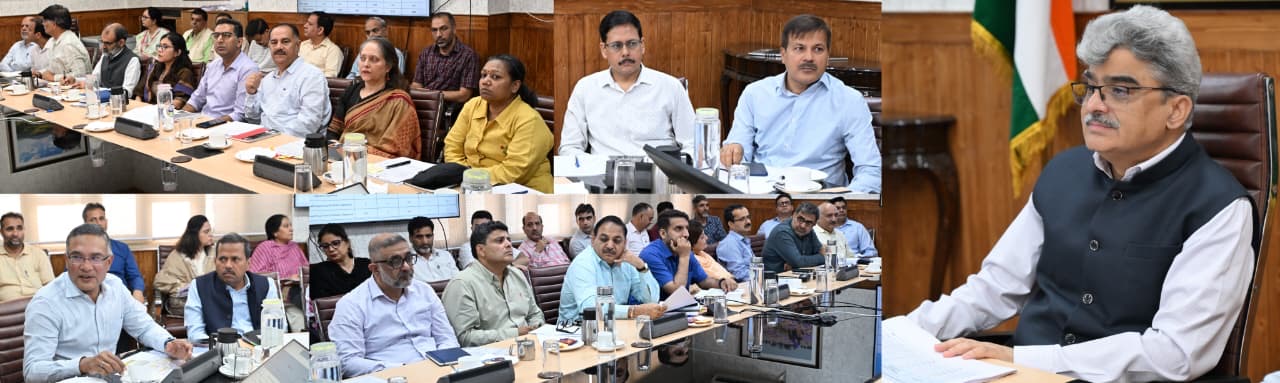
Dulloo issued the directions while chairing a meeting of Administrative Secretaries and Deputy Commissioners to review expenditure under Capital Expenditure (CAPEX), Centrally Sponsored Schemes (CSS), SASCI and NABARD-funded projects, besides assessing revenue mobilisation across major sectors.
The meeting was attended by Administrative Secretaries, Deputy Commissioners, DG Resources, DG Budget, Director Resources and senior officers and HoDs of the Finance and Planning Departments.
The Chief Secretary directed departments to complete Administrative Approvals, Technical Sanctions and tendering processes in advance so that works can be allotted immediately after release of funds.
He said advance preparation would help departments make better use of available funding windows and accelerate creation of public infrastructure.
Dulloo also directed departments to make dedicated efforts towards implementing incentive-linked reforms prescribed under SASCI, noting that successful completion of these reforms could enable Jammu & Kashmir to secure additional funding.
He asked departments to identify suitable works that could be taken up through such additional resources. School Education, Jal Shakti, Higher Education, Culture, Science & Technology, Irrigation and Power departments were specifically urged to identify priority projects.
Weekly report on capital works
Reviewing progress under UT and District CAPEX, Dulloo directed the Planning Department to submit a weekly report on works tendered and allotted by departments and districts.
He asked Administrative Secretaries and Deputy Commissioners to ensure that every approved work is allotted within the shortest possible timeframe, stressing that budgetary allocations must translate into actual execution on the ground without avoidable delays.
The Chief Secretary also called for closer monitoring of tendering and allotment processes to accelerate implementation of capital works.
Focus on power sector reforms
Dulloo directed the Power Development Department to constitute a committee under the Engineer-in-Chief, with senior engineers as members, to assess the performance of field functionaries, particularly their role in improving billing and collection efficiency.
Observing that the power sector remains a major source of fiscal pressure for J&K, he called for sustained reforms to improve its financial position.
He also directed the department to develop an end-to-end digital mechanism to track every unit of energy supplied to the distribution system, with the objective of ensuring accountability throughout the supply chain.
₹1,231 crore mapped under SASCI Part-I
ACS Finance Shailendra Kumar presented the roadmap for leveraging SASCI and other reform-linked funding opportunities.
Under SASCI Part-I for 2026-27, project proposals worth ₹1,231 crore covering 219 projects have been mapped. Of this, ₹412.83 crore has been sought by the Power Development Department and ₹158.83 crore by the Health sector.
Under SASCI Part-II, assistance of ₹176 crore has been sought for 10 critical schemes, including ₹46 crore for the Flexible Pool for RCH and Health System Strengthening and ₹45 crore for PMGSY.
Kumar stressed that departments and districts must ensure that approved works move swiftly from planning and tendering to execution while improving financial management and utilisation of available Central assistance.
42,219 District CAPEX works receive administrative approval
The meeting was informed that under the District CAPEX Budget 2026-27, 42,219 of the 47,794 new works—around 88 per cent—have received Administrative Approval, while 13 per cent have so far been allotted.
The District CAPEX allocation stands at ₹1,236.08 crore across 20 districts, with an additional special allocation of ₹3 crore per district.
Against 29,193 completed works, 2,376 have so far been physically verified through the online Physical Verification portal.
CSS CAPEX budget at ₹10,632 crore
The Finance Department informed the meeting that the CSS CAPEX Budget Estimate for the current financial year stands at ₹10,632 crore.
Rural Development has the highest allocation at ₹2,655.1 crore, followed by Housing & Urban Development at ₹1,877.6 crore and the Public Works Department at ₹1,694.4 crore.
On the Integrated Financial Management Information System (IFMIS), the meeting was informed that three of its nine core modules have been fully implemented. Completion of the remaining modules could enable J&K to avail an incentive of up to ₹200 crore.
The presentation also highlighted a potential incentive of up to ₹650 crore under Digital Public Infrastructure for Agriculture through creation of an AgriStack-enabled Farmer Registry, besides another potential incentive of ₹105 crore under Compressed Bio-Gas reforms.
₹1,288 crore NABARD projects prepared
Regarding NABARD-RIDF projects, the Finance Department informed that 157 projects under RIDF XXVII to XXXI have been completed, with total disbursement of ₹2,301 crore.
A further 227 project proposals worth ₹1,288 crore have been prepared under RIDF-XXXII. The concerned departments have been given 15 days to upload the proposals on the NABARD portal.
GST collections cross ₹3,292 crore
The meeting also reviewed revenue mobilisation across major revenue-generating departments.
GST collections during 2026-27 have reached ₹3,292.38 crore, while J&K recorded a return-filing rate of 96.78 per cent, higher than the national average of 95.73 per cent.
The Excise Department has recorded year-to-date collections of ₹782 crore, while the Stamps & Registration Department has realised ₹248.3 crore.
The meeting also reviewed the financial position of the power sector. Power purchase costs were reported at ₹2,697 crore against receipts of ₹1,747 crore, resulting in a gap of around ₹940 crore for the ensuing financial year.
The meeting concluded with emphasis on timely implementation of reforms, strengthening revenue collection, improving expenditure efficiency and maximising available funding opportunities for creation of public infrastructure across Jammu & Kashmir.
It’s interesting to see J&K plan such a significant investment with 219 projects under SASCI. I hope these initiatives will positively impact the local economy and create job opportunities. this one
Hey there! I’ve been reading your web site for a long time now and finally got the courage to go ahead and give you a shout out from Lubbock Tx! Just wanted to say keep up the fantastic work!