I am an apple farmer, and like thousands of other growers across Kashmir, I have watched our horticulture sector change dramatically over the years. We have seen better varieties, high-density plantations, improved packaging, modern grading and, importantly, the emergence of Controlled Atmosphere (CA) storage. I have no doubt that CA storage has brought significant benefits to our apple economy. It has helped farmers hold their produce longer, reduce distress sales and make our value chain more organised.
But as a farmer, I am increasingly worried about what is happening alongside this development.
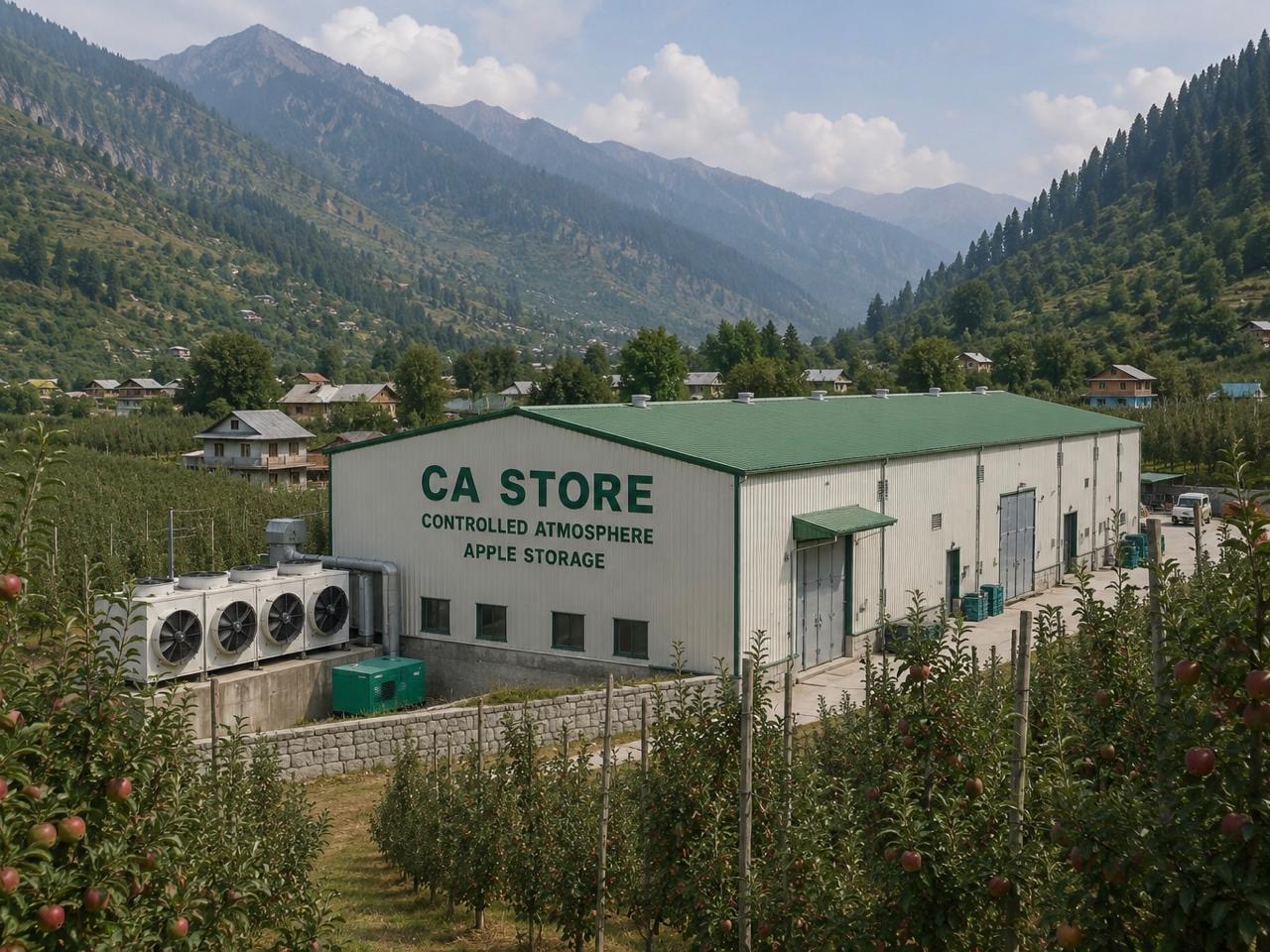
In many orchard belts, CA storage facilities are coming up at a pace that deserves serious public scrutiny. What concerns me most is not the existence of CA stores, but where and how they are being established. Productive orchards are being cut down to make space for large industrial structures, sometimes right in the middle of villages and alongside functioning orchards.
This is a contradiction that we cannot ignore. We are telling farmers to plant more orchards, adopt high-density cultivation and increase horticultural productivity, while at the same time allowing productive orchard land to be converted into industrial sites.
If this continues unchecked, we may slowly lose the very agricultural landscape that sustains Kashmir’s rural economy.
What happens inside a CA store does not necessarily stay inside it
There is another issue that worries me as a grower: biosecurity.
A CA store can receive apples from different districts and production zones. Not every consignment arrives in perfect condition. Apples may carry latent fungal infections, bacterial contamination or different post-harvest diseases. During prolonged storage, some quantity of fruit inevitably deteriorates.
As a farmer, I want to know what happens to that diseased and decomposing material.
If decayed apples, rejected fruit and other biological waste are not handled scientifically, they can become a source of fungal spores, pathogens and insects. These organisms do not recognise the boundary wall of a CA store. They can potentially move through air, water, insects, rodents and contaminated waste.
Over several seasons, a poorly managed facility could become a reservoir of disease organisms.
For an orchardist, this is not a theoretical concern. A disease entering a healthy orchard can mean additional pesticide applications, higher production costs, lower yields and poorer fruit quality. At a time when Kashmir is trying to strengthen the reputation and export competitiveness of its apples, we cannot afford to create new phytosanitary risks within our major orchard belts.
This is why I believe every new CA facility should be assessed not merely as a commercial building, but also from the perspective of orchard biosecurity.
What about the wastewater?
There is another question that needs an honest answer: where does the wastewater go?
Apple grading and washing operations can generate wastewater containing organic matter and potentially residues associated with fungicides, pesticides, waxes and other post-harvest treatments. In villages where proper treatment infrastructure may not exist, there is a risk that wastewater could find its way into open drains, agricultural fields or the soil.
For people living nearby, groundwater is not an abstract environmental issue. It is the water we drink.
If industrial activities are taking place within villages, groundwater quality must be monitored regularly. We should not wait for contamination to become visible before we start asking questions.
The same applies to rejected and rotten fruit. Decomposing apples can produce foul odours, attract insects and rodents and create microbial and waste-management problems if they are simply dumped nearby.
We need zoning, not a blanket ban
I want to make one thing clear: I am not against CA storage.
Farmers need modern post-harvest infrastructure. Kashmir cannot remain dependent on traditional storage and distress sales. CA stores have an important role in improving farmer incomes and strengthening the apple value chain.
What I oppose is unplanned development.
A CA store is an industrial facility. It requires land, water, electricity, refrigeration systems, waste management, vehicle movement and, in some cases, refrigeration systems involving ammonia. Such facilities should therefore be located according to scientific land-use planning rather than simply wherever land is available.
We need clear zoning regulations identifying where such facilities can and cannot be established. Highly productive orchard areas, dense residential settlements, schools, hospitals and environmentally sensitive locations should receive special protection.
The conversion of productive orchard land should also face much stricter scrutiny. Once a mature orchard is cut down and a concrete structure is built on it, we cannot simply reverse the decision when we realise years later that we have made a mistake.
The NOC process needs greater scrutiny
I am particularly concerned about the way approvals and No Objection Certificates are being granted.
Before permitting a large CA facility in an orchard village, authorities should be able to answer some basic questions: How will rotten fruit be disposed of? Where will wastewater go? What is the groundwater risk? What happens in the event of an ammonia leak or fire? How much water will the facility consume? How will heavy trucks affect the village? What is the potential impact on neighbouring orchards?
Most importantly, what is the cumulative impact if several such facilities come up in the same horticulture belt?
A single facility may appear manageable. Ten or twenty facilities concentrated in one orchard landscape could create an entirely different environmental situation.
This is where scientific assessment and long-term planning become essential.
I believe new CA projects should undergo appropriate environmental and biosecurity assessments, with strict wastewater and solid-waste management requirements. Groundwater around existing facilities should be periodically tested. There should be clear distance and safety norms from residential areas and sensitive public institutions. Compliance should not end with the issuance of an NOC; it should continue throughout the operational life of the facility.
The Horticulture Department, Pollution Control Committee, agricultural scientists, environmental experts, local administration and representatives of farmers should jointly monitor these developments.
Kashmir cannot sacrifice its orchards in the name of modernisation
Our orchards are not simply pieces of land. For my family and for thousands of families like mine, an orchard is a livelihood, an inheritance and a part of Kashmir’s rural landscape. It provides employment to farm workers, supports transporters, labourers, traders, nursery operators, packaging businesses and countless others.
The answer to the challenges facing horticulture cannot be to gradually replace productive orchard land with industrial structures.
We need CA storage, but we need it in the right places, under the right regulations and with the right safeguards.
The Government of Jammu & Kashmir should therefore urgently review the manner in which new CA facilities are being approved in orchard belts and villages. A scientific zoning policy should identify strategic horticulture areas where productive orchards receive special protection. Environmental, groundwater, waste-management, fire-safety and biosecurity requirements should be made integral to the approval process.
There should also be a long-term policy that looks beyond the immediate investment or storage capacity being created and asks a much more important question:
What will this decision mean for Kashmir’s orchards 20 or 30 years from now?
As farmers, we are constantly asked to think about the future. We are told to plant trees that may take years to reach their full potential. We invest our savings today for a harvest that may come many seasons later.
I expect the same long-term thinking from policymakers.
Modern infrastructure should strengthen our orchards, not consume them. CA stores should become partners in Kashmir’s horticultural future—not agents of its gradual industrial conversion.
If we allow productive orchards, groundwater and village environments to be sacrificed for unplanned infrastructure today, we may discover tomorrow that we have damaged the very ecosystem that made Kashmir’s apple industry possible.
Development is necessary. But development that destroys the foundation of the economy it is supposed to support cannot be called sustainable.
As an apple farmer, that is the future I want the government to protect.
Các cửa hàng CA nên tập trung vào việc cung cấp sự hỗ trợ cho nông dân Kashmir để duy trì và phát triển những vườn cây truyền thống, không chỉ để bảo tồn văn hóa mà còn để đảm bảo sự phát triển bền vững cho cộng đồng. recommended
Việc bảo vệ những vườn cây của Kashmir không chỉ có ý nghĩa kinh tế mà còn là biểu tượng của văn hóa địa phương. Các cửa hàng CA thực sự cần nhận thức rõ điều này để hỗ trợ và hợp tác chứ không phải thay thế. good resource
Việc ủng hộ và phát triển những vườn cây trái của Kashmir là rất quan trọng trong việc bảo vệ văn hóa nông nghiệp của khu vực này. Các cửa hàng CA cần có những chính sách cụ thể để hỗ trợ nông dân và không chỉ đơn thuần thay thế sản phẩm của họ. check this out
Các cửa hàng CA nên xem xét các cơ hội hợp tác với nông dân Kashmir để giúp họ giữ gìn và phát triển các vườn trái cây của mình, từ đó tạo ra giá trị bền vững cho cả cộng đồng. helpful site
Great goods from you, man. I’ve take into accout your stuff previous to and you are simply extremely fantastic. I actually like what you have got right here, really like what you are saying and the way by which you say it. You make it entertaining and you continue to take care of to keep it smart. I can’t wait to learn much more from you. This is actually a terrific site.
Các cửa hàng CA cần hiểu rõ tầm quan trọng của việc hỗ trợ ngành nông nghiệp tại Kashmir, không chỉ là tiêu thụ trái cây mà còn bảo vệ di sản văn hóa của khu vực. interesting find


Experience the realism of a truly dynamic society https://thebustlingworld.pages.dev
Nếu đang tìm hiểu về fly888, bạn nên tham khảo thông tin từ nhiều nguồn để có góc nhìn đầy đủ.
Giao diện của fly88.tel khá đơn giản và dễ thao tác.
Các cửa hàng CA cần hỗ trợ nông dân Kashmir, giúp bảo tồn những vườn cây trái truyền thống của họ. good resource
Các cửa hàng CA nên tập trung vào việc cung cấp sự hỗ trợ cho nông dân Kashmir để duy trì và phát triển những vườn cây truyền thống, không chỉ để bảo tồn văn hóa mà còn để đảm bảo sự phát triển bền vững cho cộng đồng. recommended
Việc bảo vệ những vườn cây của Kashmir không chỉ có ý nghĩa kinh tế mà còn là biểu tượng của văn hóa địa phương. Các cửa hàng CA thực sự cần nhận thức rõ điều này để hỗ trợ và hợp tác chứ không phải thay thế. good resource
Việc ủng hộ và phát triển những vườn cây trái của Kashmir là rất quan trọng trong việc bảo vệ văn hóa nông nghiệp của khu vực này. Các cửa hàng CA cần có những chính sách cụ thể để hỗ trợ nông dân và không chỉ đơn thuần thay thế sản phẩm của họ. check this out
Các cửa hàng CA nên xem xét các cơ hội hợp tác với nông dân Kashmir để giúp họ giữ gìn và phát triển các vườn trái cây của mình, từ đó tạo ra giá trị bền vững cho cả cộng đồng. helpful site
Great goods from you, man. I’ve take into accout your stuff previous to and you are simply extremely fantastic. I actually like what you have got right here, really like what you are saying and the way by which you say it. You make it entertaining and you continue to take care of to keep it smart. I can’t wait to learn much more from you. This is actually a terrific site.
0ijnru
p7nofg
i8ut8y
Các cửa hàng CA cần hiểu rõ tầm quan trọng của việc hỗ trợ ngành nông nghiệp tại Kashmir, không chỉ là tiêu thụ trái cây mà còn bảo vệ di sản văn hóa của khu vực. interesting find
Some genuinely excellent content on this site, regards for contribution. “A man with a new idea is a crank — until the idea succeeds.” by Mark Twain.