The fight against drug abuse is not merely a government programme; it is a struggle to protect society, families, and the future of the younger generation. In recent years, Jammu & Kashmir has witnessed growing concern over the spread of narcotics and substance addiction among youth, making the issue one of the most serious social challenges confronting the Union Territory. Against this backdrop, the “One Hundred Days Nasha Mukteh Programme” has emerged as a major awareness initiative aimed at mobilising society against the menace of drugs.
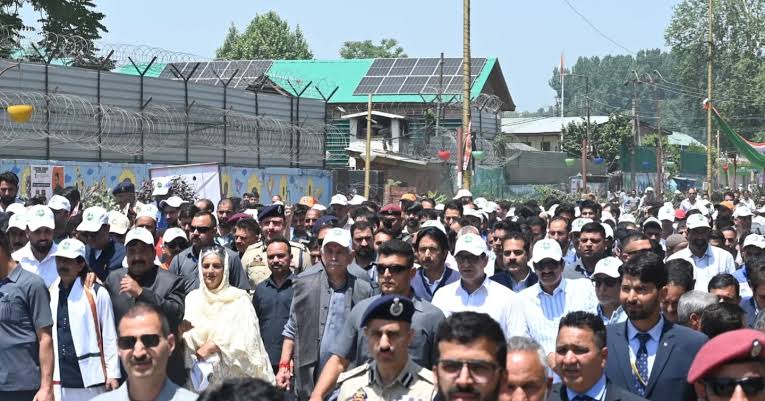
The recent Ped Yatra led by the Lieutenant Governor in Anantnag marked a significant moment in this campaign. The participation of students, youth, civil society members, government employees, and ordinary citizens transformed the event from an official programme into a broader people’s movement. The march carried a direct message against drug abuse and trafficking while reflecting public solidarity in the fight against addiction.
The importance of the event lay not merely in symbolism but in the sense of collective responsibility it created. It demonstrated that the battle against drugs cannot be fought by law enforcement agencies alone. Families, educational institutions, civil society organisations, religious leaders, and communities all have a role in protecting young people from addiction. The image of thousands of people marching together against narcotics sent a powerful signal that society is no longer willing to remain silent on the issue.
Drug addiction today represents not only a law-and-order challenge but also a social, economic, and public health crisis. Addiction destroys families, weakens communities, damages mental and physical health, and pushes many young people towards hopelessness, unemployment, crime, and depression. In this context, campaigns like the Nasha Mukteh Programme are not ordinary administrative exercises; they are efforts to safeguard future generations.
The Ped Yatra also highlighted the importance of leadership connected with the people. Walking among ordinary citizens symbolised accessibility, solidarity, and public engagement. Such initiatives strengthen trust between the administration and society while giving emotional force to awareness campaigns. The participation of students and youth was especially encouraging, reflecting growing awareness among young people about the dangers of substance abuse and their willingness to become part of the solution.
Educational institutions have a crucial responsibility in sustaining this movement. Schools, colleges, and universities must continue awareness drives, counselling programmes, sports activities, debates, and cultural initiatives that promote healthy and constructive lifestyles. Investment in education, sports infrastructure, skill development, and employment opportunities remains one of the strongest long-term safeguards against addiction.
The role of law enforcement agencies is equally critical. Drug traffickers and peddlers profit from social destruction and therefore require strict legal action. At the same time, society must distinguish between traffickers and addiction victims. While criminal networks deserve punishment, individuals struggling with addiction need counselling, treatment, rehabilitation, and social support. A successful anti-drug strategy must combine firmness with compassion.
Families also remain the first line of defence. Parents and guardians must remain attentive to behavioural changes among young people and encourage open communication within homes. Many youth fall into addiction due to stress, unemployment, peer pressure, or emotional isolation. Strong family support systems can play a decisive role in prevention and recovery.
The anti-drug movement in Jammu and Kashmir also carries cultural and moral significance. The Valley’s social traditions have historically emphasised spirituality, morality, discipline, and community values. Preserving these values requires collective resistance against narcotics and substance abuse. Public awareness campaigns, community participation, and social engagement are therefore essential not only for public health but also for protecting the social fabric of society.
The Ped Yatra in Anantnag succeeded because it combined symbolism with seriousness. It created a sense of unity and public ownership around the anti-drug mission. More importantly, it reminded society that social reform becomes meaningful only when citizens themselves participate actively in the process.
The “One Hundred Days Nasha Mukteh Programme” represents an important beginning, but the challenge lies in sustaining momentum beyond symbolic events. Awareness campaigns must continue at the grassroots level, rehabilitation services must be strengthened, and opportunities for youth must expand. Every institution — from schools and mosques to civil society groups and local communities — must contribute to this collective effort.
The youth of Jammu & Kashmir deserve opportunity, dignity, and hope rather than addiction and despair. The Ped Yatra in Anantnag was therefore more than a public march; it was a statement of collective determination to protect the future of society. History often remembers moments when communities unite for a larger cause, and this campaign may well become one such moment in the social consciousness of Jammu & Kashmir.
1 COMMENT
I’ve been researching this unique topic and your points on 2026 embroidery is exactly what I needed.
Thanks for the detail!


I’ve been researching this unique topic and your points on 2026 embroidery is exactly what I needed.
Thanks for the detail!