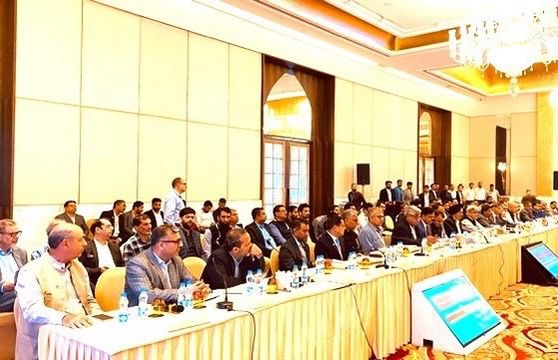
Srinagar, May 22: The Federation of Chambers of Industries Kashmir (FCIK) on Wednesday urged the Parliamentary Standing Committee on Industry to recommend a single, comprehensive and adequately funded industrial policy framework for Jammu and Kashmir to ensure parity in incentives for all categories of industrial enterprises across the Union Territory.
The demand was raised during a high-level meeting of the Parliamentary Standing Committee on Industry held in Srinagar under the chairmanship of Tiruchi Siva. The meeting was attended by 22 Members of Parliament from the Rajya Sabha along with senior government officials, bankers and representatives of industrial bodies.
Among those present were Atal Dulloo, Additional Development Commissioner MSME Praveen Kumar, Amitava Chatterjee, Commissioner Secretary Industries and Commerce Vikramjit Singh, Managing Director JKTPO Sudharshan Kumar, CEO CGTMSE Manish Sinha, besides senior representatives of Small Industries Development Bank of India, Punjab National Bank, Canara Bank, Bank of Baroda and Bank of Maharashtra.
An FCIK delegation led by Shahid Kamili submitted a detailed memorandum highlighting what it described as grave structural, financial and policy challenges confronting industries and MSMEs in Jammu and Kashmir.
Concern Over NCSS Imbalance
The Federation expressed serious concern over what it termed as a growing imbalance following the closure of registrations under the New Central Sector Scheme for Industrial Development of Jammu and Kashmir (NCSS-2021).
According to FCIK, units already registered under the scheme would continue receiving substantial incentives until 2037, while existing industrial units, revival cases and future investors outside the scheme had been left at a severe competitive disadvantage despite operating under the same regional constraints and economic hardships.
The Federation urged the Parliamentary Committee to recommend that the upcoming industrial policy for Jammu and Kashmir, presently under formulation, be backed by adequate Central funding so that incentives could be extended to existing, revived, expanding and prospective industrial units on broadly comparable lines with those available under NCSS.
FCIK argued that sustainable industrialisation could not be achieved by creating “two unequal classes of enterprises” in Jammu and Kashmir — one receiving extensive fiscal support while the other struggled without comparable incentives despite facing the same challenges of geography, logistics, instability and limited market access.
The Federation stressed that Jammu and Kashmir’s industrial sector had survived decades of disturbances, shutdowns, floods, policy disruptions and economic uncertainty and therefore deserved protection, revival and modernization rather than policy neglect.
It cautioned that continuation of the present imbalance could seriously weaken investor confidence and undermine the existing industrial base of the Union Territory.
Demand for Revival Package
Apart from industrial incentives and policy parity, FCIK strongly advocated a comprehensive revival and rehabilitation package for sick and stressed industrial units.
The Federation proposed creation of a dedicated revival corpus for modernization, rehabilitation and expansion of MSMEs across Jammu and Kashmir.
It also highlighted serious marketing and market-access challenges faced by local MSMEs following withdrawal of traditional procurement protections and increasing centralization of procurement through the Government e-Marketplace (GeM) platform.
FCIK demanded restoration of institutional procurement support, particularly in procurement by Central public sector undertakings and government agencies, besides stronger implementation of local procurement mechanisms for MSMEs in Jammu and Kashmir.
Delayed Payments, Credit Flow Issues Raised
The Federation also raised the issue of delayed payments to MSMEs by government departments and public agencies and sought strict enforcement of the MSMED Act along with automatic and binding payment enforcement mechanisms.
Special emphasis was laid on improving credit flow to MSMEs, with FCIK urging banks and financial institutions to adopt a region-sensitive lending framework for Jammu and Kashmir.
The Federation strongly advocated collateral-free financing for aspiring entrepreneurs under the Credit Guarantee Fund Trust for Micro and Small Enterprises (CGTMSE) and other Government of India schemes.
FCIK pointed out that despite government-backed guarantee cover under CGTMSE, banks continued insisting on heavy collateral security, defeating the objective of the scheme and discouraging first-generation entrepreneurs.
Parliamentary Panel Assures Support
According to the Federation, members of the Parliamentary Standing Committee responded positively and acknowledged the extraordinary challenges faced by MSMEs in Jammu and Kashmir over the past several decades.
The Committee members reportedly assured support and intervention with the Government of India for resolution of the issues raised by FCIK.
The panel also took note of the fact that industry contributes nearly 19 per cent to Jammu and Kashmir’s Gross State Domestic Product (GSDP), compared to around 30 per cent contribution of industry to the national GDP, observing that the disparity itself justified focused policy intervention and special measures to accelerate industrial growth in the Union Territory.
Government, Banks Outline Initiatives
During the meeting, Atal Dulloo made a detailed presentation on measures being undertaken by the Jammu and Kashmir administration to promote industrial growth and economic development.
He informed the Committee that the new industrial policy for Jammu and Kashmir was expected to be finalized within the next two to three months in consultation with stakeholders and that efforts were being made to accommodate the genuine concerns and aspirations of industry.
Amitava Chatterjee, assisted by CGM Ashutosh Sareen and GM Rakesh Mangotra, also gave a presentation on credit flow and assured continued support to the industrial sector in Jammu and Kashmir.
Representatives of other banks similarly expressed willingness to enhance institutional credit flow for industrial development in the Union Territory.
The vote of thanks was presented by Vikramjit Singh.