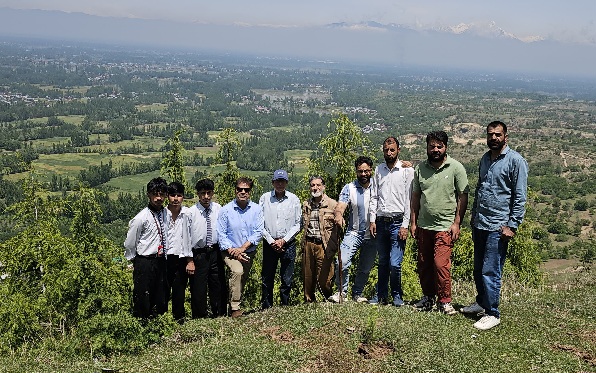
Budgam, May 6: A major conifer plantation drive was carried out on Rathsun hillock in the Beerwah area of central Kashmir’s Budgam district, with around 1,000 saplings planted in a joint initiative involving civil society, academia and government agencies.
The drive was organised by the Environmental Policy Group Kashmir in collaboration with the Jammu & Kashmir Forest Department, Boys Higher Secondary School Beerwah and Sher-e-Kashmir University of Agricultural Sciences and Technology of Kashmir.
The plantation was carried out on the slopes of Rathsun hillock, a prominent highland that houses the revered shrine of Baba Haneef ud Din and attracts thousands of devotees annually. Organisers said the initiative aims to restore green cover on the largely barren hill slopes and address soil erosion in the ecologically sensitive area.
Convenor of the Environmental Policy Group Kashmir, Faiz Bakshi, said the initiative was part of a long-term effort to revive the degraded landscape. “Rathsun hillock has very little tree cover and is facing soil erosion and environmental stress. Our aim is to work with local communities to gradually develop a full green cover on this hill,” he said.
Arjimand Hussain, Ziraat Times founder who attended the event to encourage the students, highlighted the importance of collective action. “Such initiatives show how civil society, institutions and government departments can come together to protect our fragile ecosystems. These efforts need to be expanded across Kashmir to address growing environmental challenges,” he said.
Dr Touseef Ahmed, a key member of EPG and environmental activist joined students in planting the trees and expressed hope that such collaboration would lead to more such initiatives for degraded lands in Kashmir.
Dr Rouf Ahmed of SKUAST Kashmir underlined the ecological significance of the plantation drive. “Planting on such degraded slopes is essential for controlling erosion, improving soil health and restoring ecological balance. However, long-term monitoring and protection are crucial for success,” he said.
Bacha Sahab emphasised the technical aspects of the initiative. “Rathsun hillock is highly vulnerable to soil erosion due to its fragile composition and lack of vegetation. Scientific afforestation combined with soil conservation measures is necessary to stabilise the terrain,” he said.
Mushtaq Ahmed Wani, a faculty member of Boys Higher Secondary School Beerwah and member of the Environmental Policy Group, stressed the role of youth and institutions. “Educational institutions have a key role in shaping environmental awareness. Involving students in such plantation drives not only builds responsibility but also ensures long-term community ownership of these initiatives,” he said.
Officials from the Forest Department said the plantation focused on conifer species suited to the local climate and terrain. “The species have been selected keeping in view long-term sustainability. Plantation must be followed by continuous care and community protection to ensure survival,” an official said.
Faculty members and students of Boys Higher Secondary School Beerwah actively participated in the drive, along with representatives from the SKUAST-K Entrepreneurship Incubation Centre and other stakeholders.
Speakers at the event noted that plantation drives in ecologically sensitive and culturally significant locations can have both environmental and social impact, and called for sustained collaboration among stakeholders.
The programme concluded with participants taking a pledge to continue conservation efforts and ensure the protection and upkeep of the newly planted saplings in the coming years.


http://medmennews.com/# sildenafil over the counter