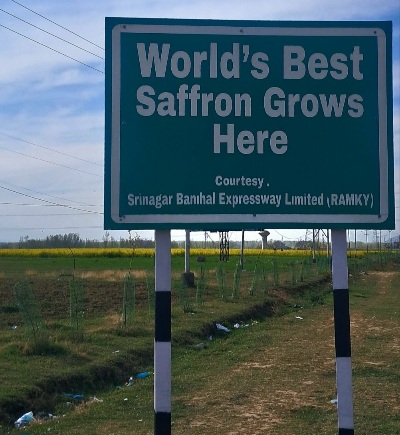
The pride of the valley, the karewas of Pampore, are undergoing a silent transformation driven by structural issues such as declining yields, higher input costs, climate uncertainty, and an opaque market system. Estimates from the local agricultural department and field reports suggest that nearly 2,000–2,500 kanals of traditional saffron land have been converted into mustard fields. The transformation may be rational at the individual level; however, it reflects a persistent policy failure—one that poses a serious long-term threat to Kashmir’s ecological balance, economic potential, and cultural identity. The solution to this does not lie in mending the farmers’ behavior but in rectifying market distortions, providing input subsidies, improving irrigation support, and undertaking broader institutional reforms so that short-term benefits do not override long-term value.
Risk aversion under uncertainty compels farmers to make this transition. Saffron, despite being a high-value crop priced at ₹1.5 lakh to ₹3 lakh per kilogram, is highly sensitive to climatic and market fluctuations. Kashmir’s saffron productivity (traditional and rejuvenated combined) has fallen from 6.33 kg per hectare in 2023–24 to 5.27 kg per hectare in 2024–25. Overall production has also declined from 23.53 metric tons to 19.58 metric tons during the same period. Over the longer term, the area under cultivation has shrunk from over 5,700 hectares in 1996–1997 to nearly 3,200 hectares in 2019–2020, according to data from the J&K Agriculture Department and National Saffron Mission. Mustard, by contrast, offers lower but more stable returns and predictable cash flows. In an environment marked by climate volatility and weak market assurance due to opaque price determination and trader-controlled negotiations, farmers apply high discount rates to future income and prioritize present stability over uncertain future gains.
However, what is rational for an individual may not be optimal for the economy. The transition from high-value, globally recognized, and export-oriented saffron with a Geographical Indication (GI) tag to a low-value oilseed will lead to reduced long-term income potential and undermine Kashmir’s comparative advantage in saffron production.
The transition will not only hurt the economy but also have ecological consequences. It will alter the soil composition, cropping cycles, and water usage patterns, potentially degrading land quality, which once lost will lead to irreversible damage. Experiences from Punjab and Haryana show how short-term gains can generate long-term environmental costs. The shift during the Green Revolution from traditional crops to water-intensive crops like rice and wheat led to severe groundwater depletion, soil degradation, and loss of biodiversity, although initially boosting productivity and incomes.
Beyond economics and ecology lies the question of identity. Saffron is not merely an agricultural commodity; it is embedded in Kashmir’s cultural heritage, tourism economy, and global image. The gradual erosion of saffron cultivation risks transforming not just land use patterns, but also the symbolic and economic identity of the region.
The government has attempted to address these challenges through a ₹411-crore National Saffron Mission (2010–11) and the granting of a Geographical Indication (GI) tag in 2010. While some progress has been made, it is hard to undo the deep and persistent structural gaps that ultimately hinder program implementation, transparent market access, and price realization. Farmers continue to face uncertainty, with intermediaries capturing a significant share of the value and incentivizing the shift toward alternative crops, particularly oilseeds.
To reverse the trend, a comprehensive policy framework is needed. Isolated interventions or a mere ban on land conversion would not be sufficient. The state has to intervene. Price assurance mechanisms such as price deficiency payments or state-backed procurement for export can reduce downside risk. Institutional reforms are the need of the hour. What Kashmir needs now is not another mission, but institutions with capabilities to transform.
Saffron cooperatives must play their part and invest in productivity and branding. They should aggregate produce, conduct transparent auctions, enforce GI standards, invest in testing and packaging infrastructure, and negotiate export contracts. Ultimately, this would convert saffron farmers from price-takers into shareholders in the value chain, much as Amul did for dairy farmers.
The ongoing transition is not merely an agricultural adjustment but a reflection of deeper economic, ecological, and institutional challenges. While farmers are being rational and responding to immediate incentives, the cumulative impact is a decline in economic value, ecological degradation, and the loss of the globally recognized heritage of the valley—an outcome rooted in policy failure within the economic and institutional framework that does not adequately reward long-term value creation.
The state must roll out a policy to align short-term incentives with long-term sustainability, ensuring that Kashmir’s saffron land does not shrink further and remains both profitable and resilient. Only with policy correction and people’s active support can this unique natural and economic asset be preserved for generations to come.