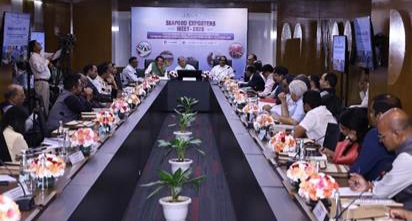
New Delhi, April 11: Union Minister for Fisheries, Animal Husbandry and Dairying Rajiv Ranjan Singh on Saturday chaired the Seafood Exporters Meet 2026 in New Delhi, where the government and industry stakeholders outlined a roadmap to expand India’s global seafood market reach and scale up value-added exports.
The meeting, organised by the Department of Fisheries at Ambedkar Bhawan, brought together senior government officials, exporters, and industry representatives to deliberate on challenges related to market access, compliance, and pricing, while identifying strategies for diversification and growth.
Addressing the gathering, the Union Minister highlighted that India’s seafood exports have grown from ₹62,000 crore last year to around ₹68,000 crore this year, marking an increase of approximately ₹6,000 crore despite global uncertainties. He urged exporters to work towards achieving the ₹1 lakh crore export target by focusing on value addition, improved quality standards, and market diversification.
Singh emphasised the need for strict adherence to regulatory norms, including antibiotic-free production and robust traceability systems, to maintain global competitiveness. He also underscored the untapped potential of India’s Exclusive Economic Zone (EEZ) and high seas, particularly for high-value species such as tuna from the Andaman and Nicobar Islands.
Calling for infrastructure upgrades, the Minister stressed the importance of better onboard handling, modern cold-chain systems, improved packaging, and reduction of post-harvest losses. He added that the government is operationalising EEZ rules through access passes, with priority for cooperative societies to promote inclusive growth.
Minister of State George Kurian said the fisheries sector is being positioned as a high-value and high-demand segment of the economy, with a focus on strengthening value chains, logistics, and certification systems to sustain export growth.
Union Fisheries Secretary Abhilaksh Likhi said a focused market diversification strategy is being implemented in coordination with agencies such as MPEDA, Export Inspection Council (EIC), and the Department of Commerce. He noted that diplomatic outreach to nearly 40 countries has opened new opportunities, especially for ready-to-eat and value-added seafood products. He added that exporters would be linked more closely with Indian missions abroad to expand market access.
Industry stakeholders welcomed the government’s proactive approach but flagged key challenges, including tariff and non-tariff barriers, high compliance costs, limited value-addition capacity, and gaps in cold-chain infrastructure. They also called for streamlined procedures for catch certificates, support for seaweed cultivation in the Andaman and Nicobar Islands, and greater focus on inland fisheries and mariculture.
Officials from key institutions including MPEDA, National Fisheries Development Board (NFDB), NABARD, National Cooperative Development Corporation (NCDC), and the Ministry of Food Processing Industries attended the meeting, along with representatives from export associations and private sector companies.
According to official data, India’s seafood exports have grown at an average annual rate of 7 per cent over the past decade, more than doubling from ₹30,213 crore in 2013-14 to over ₹62,000 crore in 2024-25. The country exports over 350 seafood products to nearly 130 markets, with the United States remaining the largest destination, followed by China, the European Union, Southeast Asia, Japan, and the Middle East.
The government is pushing diversification under the Pradhan Mantri Matsya Sampada Yojana (PMMSY), with investments in aquaculture, disease management, traceability, and post-harvest infrastructure to strengthen India’s position in global seafood trade.