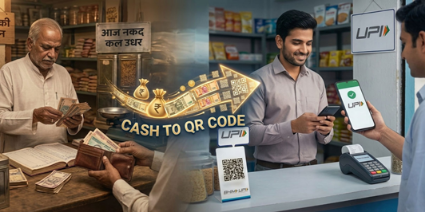
New Delhi, April 11: India’s financial landscape has undergone a dramatic transformation over the past decade, evolving from cash-dominated, time-consuming transactions to a fast, seamless, and inclusive digital payments ecosystem driven by innovations such as the Unified Payments Interface (UPI).
According to a government background note released on Saturday, the shift has fundamentally changed how individuals, businesses, and institutions transact, making payments faster, simpler, and more accessible across the country.
The report traces India’s journey from traditional systems—where bill payments required long queues and money transfers took days—to a modern, real-time digital infrastructure. Earlier banking systems such as Real-Time Gross Settlement (RTGS) introduced in 2004 and Immediate Payment Service (IMPS) in 2010 marked initial progress, but their reach remained limited to those already within the formal banking network.
A major turning point came with the rollout of the JAM Trinity—Jan Dhan accounts, Aadhaar, and mobile connectivity—which laid the foundation for large-scale financial inclusion. The Pradhan Mantri Jan-Dhan Yojana expanded access to banking, Aadhaar enabled digital identity verification, and widespread mobile penetration brought millions into the digital ecosystem.
This framework enabled the success of the Direct Benefit Transfer (DBT) system, which streamlined welfare delivery and familiarised citizens with digital transactions, paving the way for the rapid adoption of UPI.
Launched in 2016 by the National Payments Corporation of India, UPI revolutionised payments by allowing instant, round-the-clock transfers using simple identifiers such as mobile numbers or virtual payment addresses, eliminating the need for bank account details and IFSC codes.
The system has since scaled rapidly, growing from 216 participating banks in 2021 to 691 by January 2026. In January 2026 alone, UPI processed 21.7 billion transactions worth ₹28.33 lakh crore, accounting for 81 per cent of India’s retail digital payments and nearly 49 per cent of global real-time transactions, making it the world’s largest system by volume.
The government said UPI’s low-cost and interoperable architecture has driven widespread adoption across income groups and geographies. From street vendors and small merchants to rural households, digital payments have become an integral part of daily life, reducing dependence on cash and improving financial inclusion.
The ecosystem continues to evolve with features such as UPI Lite for small-value transactions, UPI AutoPay for recurring payments, and credit integration that enables access to pre-approved loans through digital platforms. These innovations are expanding access to credit, insurance, and savings, particularly for small businesses and informal workers.
To strengthen security, the Reserve Bank of India has introduced enhanced authentication measures, including mandatory two-factor authentication for digital transactions from April 1, 2026, aimed at reducing fraud risks and boosting user confidence.
India’s digital payments model has also gained global recognition, with institutions such as the International Monetary Fund and World Bank acknowledging its scale and inclusiveness. UPI has expanded internationally and is now linked with payment systems in several countries, including the UAE, Singapore, France, and Nepal, facilitating cross-border transactions and remittances.
The government described UPI as more than a payment tool, calling it a platform that has bridged the gap between the banked and unbanked populations. It said the transformation from queues to QR code-based payments reflects the success of inclusive digital innovation in reshaping India’s economic landscape.