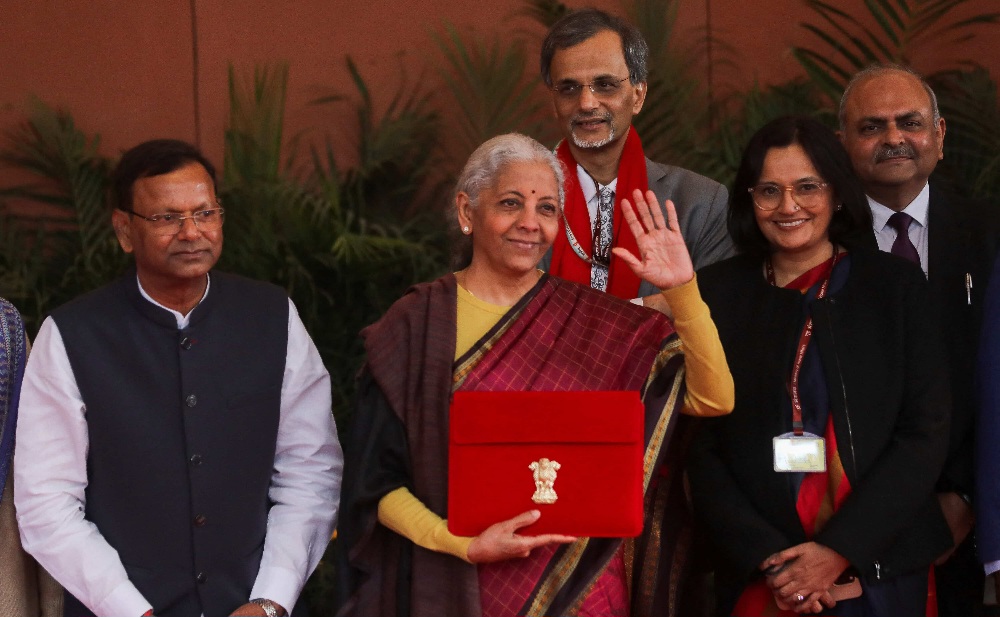
New Delhi, Feb 1: Union Finance and Corporate Affairs Minister Nirmala Sitharaman on Saturday tabled the Union Budget 2026–27 in Parliament, outlining a roadmap centred on accelerating economic growth, building human capacity and ensuring inclusive development under the guiding vision of Sabka Saath, Sabka Vikas. The budget, the first prepared in Kartavya Bhawan, is anchored around three core “kartavyas” or duties.
Fiscal Position and Budget Estimates
The Union Government has estimated total expenditure at ₹53.5 lakh crore for 2026–27, while non-debt receipts are projected at ₹36.5 lakh crore. Net tax receipts of the Centre are estimated at ₹28.7 lakh crore. Gross market borrowings are pegged at ₹17.2 lakh crore, with net borrowings from dated securities at ₹11.7 lakh crore.
The fiscal deficit for 2026–27 is estimated at 4.3 per cent of GDP, slightly lower than the revised estimate of 4.4 per cent for 2025–26. The debt-to-GDP ratio is projected to decline to 55.6 per cent, indicating gradual fiscal consolidation.
Push to Accelerate and Sustain Economic Growth
The first kartavya of the budget focuses on accelerating and sustaining economic growth through six key interventions, led by a major push to manufacturing, infrastructure and energy security.
To strengthen manufacturing, the government announced the Biopharma SHAKTI initiative with an outlay of ₹10,000 crore over five years to position India as a global biopharma hub. India Semiconductor Mission 2.0 will be launched to develop domestic capabilities in semiconductor equipment, materials and intellectual property, while the outlay for the Electronics Components Manufacturing Scheme has been increased to ₹40,000 crore.
The budget also proposes dedicated Rare Earth Corridors in mineral-rich states, new chemical parks, hi-tech tool rooms, a container manufacturing scheme with an allocation exceeding ₹10,000 crore, and a comprehensive programme for strengthening capital goods manufacturing. The textile sector will receive focused support through the National Fibre Scheme, modernisation of traditional clusters and new mega textile parks.
Legacy industrial clusters will be rejuvenated through a new scheme covering 200 clusters, while small and medium enterprises will be supported through a ₹10,000 crore SME Growth Fund and additional capital infusion into the Self-Reliant India Fund.
Public capital expenditure is proposed to rise to ₹12.2 lakh crore, alongside the creation of an Infrastructure Risk Guarantee Fund to crowd in private investment. New freight corridors, expansion of inland waterways, promotion of coastal shipping and incentives for seaplane manufacturing were also announced.
To ensure long-term energy security, ₹20,000 crore has been allocated for carbon capture, utilisation and storage technologies. Seven high-speed rail corridors connecting major cities have been proposed as growth connectors.
Building Human Capacity and Fulfilling Aspirations
The second kartavya aims to build human capital and employment opportunities. A high-powered standing committee on education-to-employment pathways will be set up, with a focus on the services sector.
The budget proposes adding 1 lakh allied health professionals over five years, setting up five regional medical hubs to promote medical tourism, establishing new Ayurveda institutes, and scaling up veterinary education and infrastructure. Education initiatives include university townships near industrial corridors, girls’ hostels in every district, and skill development programmes for tourism and creative industries.
The Khelo India Mission will be launched to transform the sports sector over the next decade.
Inclusive Development and Regional Focus
Aligned with the third kartavya of inclusive development, the budget prioritises increasing farmers’ incomes through high-value agriculture, integrated development of reservoirs and Amrit Sarovars, and the launch of Bharat-VISTAAR, an AI-enabled multilingual agricultural advisory platform.
Targeted initiatives have also been announced for Divyangjan skill development, mental health care including the establishment of NIMHANS-2 in north India, and focused development of the Purvodaya states and the North-East through industrial corridors, tourism projects and e-bus deployment.
Tax Reforms and Ease of Living
On the taxation front, a new Income Tax Act will come into effect from April 2026 with simplified rules and forms. Several measures have been announced to enhance ease of living, including exemptions on certain incomes, rationalisation of TDS and TCS provisions, extended timelines for filing returns, and simplified compliance for small taxpayers.
The government also proposed rationalising penalties and prosecution to reduce litigation, providing relief to cooperatives, and strengthening India’s IT sector through higher safe harbour thresholds and faster pricing agreements.
In indirect taxes, the budget proposes tariff simplification, customs duty exemptions to support energy transition, electronics, aviation and critical minerals, and enhanced trade facilitation through trust-based customs systems.
Support to States and Conclusion
As per the recommendations of the 16th Finance Commission, ₹1.4 lakh crore has been provided to states as grants for 2026–27.
Overall, the Union Budget 2026–27 outlines a broad-based strategy combining fiscal prudence, investment-led growth, structural reforms and social inclusion, aimed at steering India towards the goal of a Viksit Bharat by 2047.