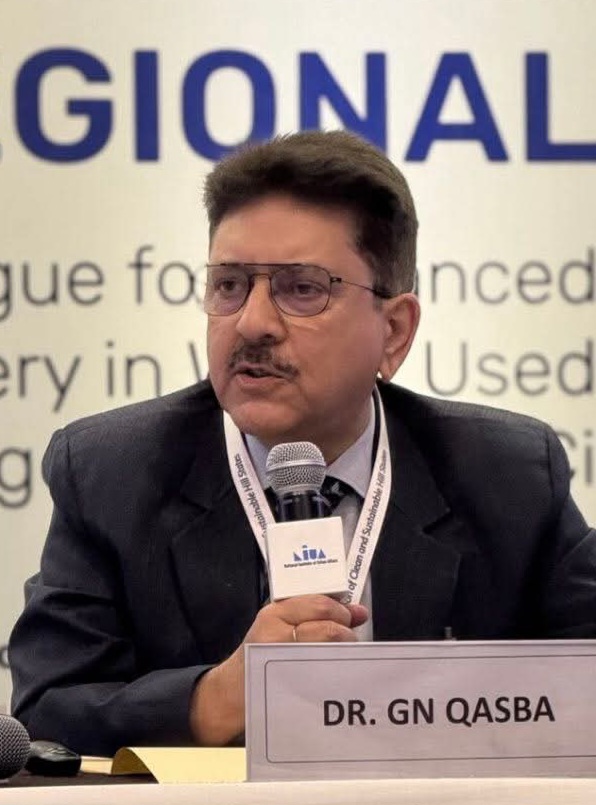
By Dr G. N. Qasba Former Commissioner, Srinagar Municipal Corporation
The Economic Survey 2025–26 has flagged a silent but growing risk that India’s cities can no longer afford to ignore – unplanned urban expansion. Cities like Srinagar and Jammu sit squarely at the centre of this unfolding challenge.
The Survey’s recommendation that every city with a population above one million must adopt a 20-year City Spatial and Economic Plan, reviewed every five years, with clear and non-negotiable commitments on transport, housing and land-value capture, is particularly relevant for Jammu and Srinagar. For these two cities, this is not an abstract policy suggestion—it is an urgent necessity.
Both cities are experiencing rapid horizontal sprawl, worsening traffic congestion, mounting pressure on water bodies and flood plains, unchecked growth of informal housing, and a steady erosion of public spaces. In Srinagar, the costs of poor planning are magnified by its fragile ecology and high flood vulnerability. In Jammu, ribbon development and unregulated peri-urban expansion are gradually undermining livability and urban efficiency.
By 2036, India’s cities are projected to house nearly 60 crore people and contribute close to 70 per cent of the national GDP. Jammu and Srinagar are expected to function as key regional growth anchors in this urban future. Yet, despite this strategic importance, both cities continue to operate largely through fragmented projects and short-term fixes. Flyovers, roads, housing clusters or drainage works, when planned in isolation, cannot adequately manage the combined pressures of population growth, economic transition and climate risk.
What Jammu and Srinagar require is a decisive shift towards integrated urban planning. This includes transit-oriented and climate-resilient transport systems, affordable and well-located housing closely linked to employment zones, protection of lakes, rivers, flood plains and green buffers, and smart land-value capture mechanisms to sustainably finance public infrastructure.
This agenda goes far beyond infrastructure creation. For Jammu and Srinagar, planned urbanisation is fundamentally about economic competitiveness, disaster resilience, social equity and quality of life. If planned well, these cities can emerge as sustainable growth engines for the entire region. If planned poorly, they risk becoming increasingly congested, environmentally fragile and economically inefficient.
The choice is clear, and so is the timing. The window of opportunity is now.