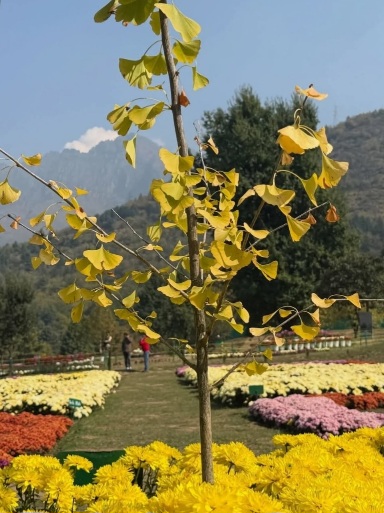
The very mention of the term “living fossil” immediately evokes two enduring icons of natural history: Ginkgo biloba and the horseshoe crab. My own first encounter with Ginkgo was not through a textbook, but through the passionate voice of my botany teacher, Prof. Shafi Uddin, at Degree College Anantnag around 1979–80. With unmistakable conviction, he urged us to someday visit Lal Mandi, Srinagar, to see for ourselves a tree unlike any other. He explained why Ginkgo biloba occupies a singular place in botanical history, its lineage stretching back nearly 290 million years, long before dinosaurs walked the Earth.
He spoke of its origins in China and East Asia, its medicinal virtues, and its extraordinary geological and evolutionary significance. Yet, with the passage of time and reflection, it is not merely the antiquity of Ginkgo that continues to move me
is its resilience. That is why the phrase “Resilience, thy name is Ginkgo” feels not only apt, but inevitable.
On August 6, 1945, when the atomic bomb “Little Boy” detonated over Hiroshima, the world witnessed destruction on a scale previously unimaginable. Within seconds, temperatures soared to nearly 7,000 degrees Fahrenheit, surpassing even the heat of volcanic lava and rivaling the surface of the sun itself. Everything within the blast radius was obliterated—human life extinguished instantly, buildings reduced to molten ruins, the city consumed by a firestorm.
And yet, in this landscape of absolute devastation, nature offered a quiet, defiant rebuttal.
Just about a mile from the hypocenter stood six Ginkgo biloba trees. Scorched, stripped of their leaves, and seemingly lifeless, they nevertheless refused to die. Within months, they sprouted anew—green shoots emerging from charred trunks, life asserting itself where death was expected to reign supreme. These trees did not merely survive; they bore witness. They endured.
This episode is not an anomaly but a chapter in the long, astonishing saga of Ginkgo biloba—a species that has survived ice ages, continental drift, mass extinctions, and relentless environmental upheaval. While countless life forms vanished into oblivion, Ginkgo persisted, largely unchanged, its distinctive fan-shaped leaves echoing a design perfected millions of years ago.
Ginkgos are not just trees; they are living monuments to evolution, to continuity, and above all, to resilience. In a world obsessed with novelty and speed, Ginkgo teaches us the power of steadfastness. It reminds us that survival is not always about adaptation through radical change, but sometimes about holding fast to what already works.
In times marked by uncertainty—ecological crises, social upheavals, personal struggles—the Ginkgo stands as a silent mentor. Scarred yet standing, ancient yet alive, it embodies the profound truth that endurance is itself a form of wisdom.
Perhaps it is time we expand our language of resilience. Alongside phrases like “tough as steel” or “unyielding as rock,” we may well add a more poetic and meaningful simile:
As resilient as Ginkgo.
For if a tree can survive the passage of 290 million years and rise again from the ashes of a nuclear inferno, surely there is hope—for nature, and for us. It is pleasing to see many Ginkgo biloba trees, though largely because of its Ornamental hues, in the Botanical gardens, parks and even personal gardens in Kashmir.
The writer is a senior former civil servant and chairman of J&K Public Service Commisison