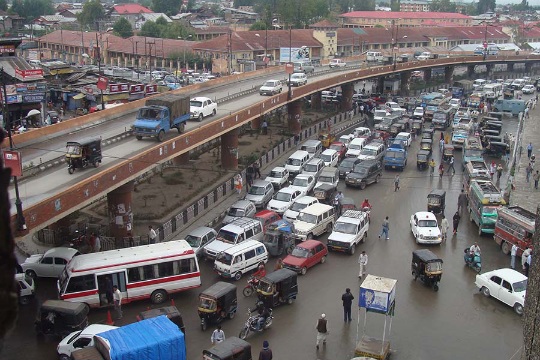
Srinagar Feb 20: Jammu & Kashmir figures among the 10 states and Union Territories with the lowest Gross State Domestic Product (GSDP) in FY 2025, according to the latest data from the Reserve Bank of India’s Handbook on Statistics of Indian States. With a GSDP of Rs 26,246 crore, the J&K ranks fourth among the lowest-performing state economies, highlighting its increasing reliance on imports, which undercut its export performance, and thereby the GSDP.
Experts believe, even as J&K’s public spending is relatively high as a proption of total spending, its low investment, reducing overall consumption due to tumbling purchasihg power and higher reliance on imports are negatively and highly impacting its overall GSDP.
The RBI data highlights a pronounced concentration of economic power in a handful of large states. Maharashtra continues to lead the country with a GSDP of Rs 45.32 lakh crore, driven by finance, manufacturing and services. It is followed by Tamil Nadu (Rs 31.19 lakh crore), Uttar Pradesh (Rs 29.78 lakh crore), and Karnataka (Rs 28.84 lakh crore), reflecting the dominance of large, industrialised and services-oriented economies.
Other major contributors to national output include West Bengal, Rajasthan, Telangana, Andhra Pradesh, Madhya Pradesh and the national capital, Delhi. Together, these states account for a substantial share of India’s total economic output.
At the lower end of the spectrum, smaller and geographically constrained states dominate the list. Arunachal Pradesh sits at the bottom with Rs 4,423 crore, followed by Tripura and Himachal Pradesh. Jammu & Kashmir, with Rs 26,246 crore, ranks just above Himachal Pradesh and below Uttarakhand.
The bottom ten also include Jharkhand, Chhattisgarh, Assam, Punjab and Odisha.
Economists attribute the relatively smaller GSDP of these regions to factors such as limited industrial bases and high reliance on imports. For Jammu & Kashmir, structural constraints, a service-dominated economy, limited large-scale manufacturing and periodic disruptions have historically shaped growth trajectories.
The RBI’s data once again brings into focus the widening economic divide between India’s industrial powerhouses and its smaller, less diversified economies — a gap that policymakers continue to grapple with in pursuit of more balanced regional development.