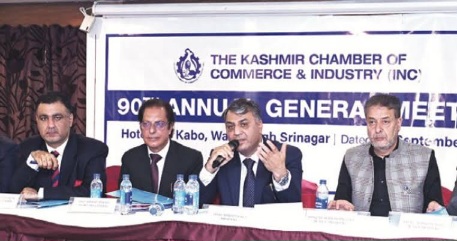
Srinagar: The Kashmir Chamber of Commerce and Industry (KCC&I), one of India’s oldest business chambers with a legacy of over 101 years, has submitted its comprehensive Budget Recommendations for the financial year 2026–27 to the Chief Secretary of Jammu and Kashmir, Atal Dulloo. The submission forms part of the Chamber’s long-standing annual institutional exercise and reflects the collective aspirations and concerns of its members representing all sectors of trade, industry, services and commerce in Kashmir.
In its budget memorandum, KCC&I observed that despite visible recovery in certain sectors, the economy of Jammu and Kashmir—particularly Kashmir—continues to remain fragile, sentiment-driven and structurally vulnerable. The Chamber pointed out that recent disruptions, including the Pahalgam incident, exposed the lack of economic shock-absorption capacity, triggering a cascading slowdown across hospitality, transport, handicrafts, horticulture marketing, MSMEs, informal labour and retail trade.
Emphasising the need for a departure from routine fiscal exercises, KCC&I stated that Budget 2026–27 must be conceived as a strategic economic blueprint focused on confidence restoration, employment generation, sectoral diversification, sustainability and long-term resilience.
Handicrafts and Export Revival
Highlighting the handicrafts sector as one of the strongest pillars of Jammu and Kashmir’s non-agricultural economy and the second-largest source of employment after agriculture, the Chamber noted that the sector has historically supported lakhs of artisans while preserving Kashmir’s cultural heritage. However, it said that over the past decade, the sector has witnessed a prolonged and structural decline, leading to large-scale unemployment, shrinking artisan incomes and erosion of traditional skills.
KCC&I pointed out that handicrafts exports, which stood at nearly ₹2,000 crore in 2013–14, declined by nearly 70–75 per cent, falling to ₹733 crore in 2024–25. The Chamber recommended treating handicrafts as an employment-intensive export industry with focused export-linked budgetary intervention.
Among its proposals, KCC&I recommended a 5 per cent export incentive on handicrafts from Jammu and Kashmir to offset cost disadvantages arising from geographical remoteness and limited connectivity. It also sought urgent upgradation of Pashmina testing and certification infrastructure, noting that the CDI Pashmina Testing Centre at Baghi Ali Mardan can currently test only 60–70 pieces per day, causing export delays and loss of buyer confidence. The Chamber urged enhancement of capacity to at least 500 pieces per day.
The Chamber also called for the establishment of content testing laboratories to meet international buyer requirements, a dedicated ₹50 crore allocation for international marketing and branding of Kashmiri handicrafts, and the establishment of an International Exhibition and Convention Mart in or around Srinagar.
Tourism and Allied Sectors
On tourism, KCC&I noted a sharp downturn following the Pahalgam attack of April 22, which resulted in widespread cancellations, reduced hotel occupancy and slowdown in ancillary services. It recommended a 5 per cent interest subvention on working capital and term loans for tourism and allied sectors, waiver and rationalisation of sanitation and municipal levies for 2025–26, and a dedicated ₹30 crore allocation for tourism promotion.
The Chamber emphasised repositioning Brand Kashmir through experience-driven and segment-specific marketing and called for planned development of tourism destinations such as Doodhpathri, Bangus, Gurez, Tosa Maidan and Wular through master plans, EIAs and carrying-capacity studies. It also stressed the need for lake restoration, adventure tourism development, preservation of houseboats as living heritage, and heritage-led regeneration of Downtown Srinagar (Shehr-e-Khas) with dedicated infrastructure and safety measures.
Agriculture, Horticulture and Food Processing
KCC&I highlighted that agriculture and horticulture contribute around 16.5 per cent to the State Gross Domestic Product and remain the backbone of the rural economy. It recommended introduction of a yield-based crop insurance scheme tailored to local agro-climatic conditions, a shift from low-value water-intensive crops to high-value low-water crops, promotion of climate-resilient farming practices, and accelerated expansion of high-density horticulture plantations.
The Chamber also sought budgetary support for subsidised agricultural input outlets, post-harvest infrastructure in North and Central Kashmir, solar energy adoption for the cold chain sector, and a comprehensive anti-hail protection programme for vulnerable orchard areas.
Industrial Revival, MSMEs and Startups
Stating that industrial growth is essential for employment generation and economic diversification, KCC&I said that revival of industry and MSMEs must form a central pillar of Budget 2026–27. It urged renewal and expansion of the New Central Sector Scheme under the J&K Industrial Policy, reforms in public procurement to ensure market access for local MSMEs, fast-track development of industrial estates, creation of a revival fund for sick units, simplification of regulatory approvals, and stronger support for startups and entrepreneurship.
General Trade and Retail Sector
The Chamber noted that the trade and retail sector is facing severe liquidity constraints and structural challenges. It recommended interest subvention on working capital loans, creation of a Market Fire Safety and Fire-Affected Traders Relief Fund, development of parking infrastructure in commercial markets, modernisation of traditional markets, formulation of a rehabilitation policy for displaced traders, rationalisation of municipal levies, and establishment of a Trade Regulatory Board for structured consultation.
Amnesty Scheme for Commercial Electricity Consumers
KCC&I recalled that while an amnesty scheme was earlier introduced for domestic consumers, a similar framework promised for commercial consumers has not yet been notified. It recommended incorporation of an amnesty scheme for commercial electricity consumers in the J&K Budget 2026–27 to enable settlement of arrears accumulated due to prolonged disruptions.
Unemployment, Environment and Social Infrastructure
The Chamber underscored the need for skill-led job creation, particularly for educated youth, and called for employment generation across agriculture, handicrafts, MSMEs, tourism, industry and allied services. It also stressed enhanced budgetary support for environmental sustainability, wetland and river restoration, afforestation, climate adaptation, water management and addressing deteriorating air quality.
On health and social infrastructure, KCC&I recommended greater investment in healthcare, sports and recreational facilities, drug de-addiction centres and mental health services to address rising substance abuse issues.
Special One-Time Settlement for Distressed Units
KCC&I urged the UT Government to make a specific budgetary provision for a Special One-Time Settlement (OTS) scheme for distressed business units whose loan accounts have turned irregular due to circumstances beyond their control. While acknowledging a more sensitive approach by the present management of J&K Bank, the Chamber expressed concern over continued SARFAESI and e-auction notices and reiterated the need for a budget-backed, time-bound OTS framework as per MSME guidelines.