

Ziraat Times Team Report
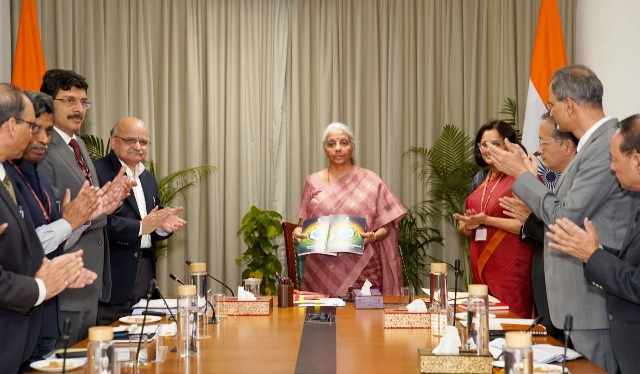
New Delhi, February 27: The Ministry of Statistics and Programme Implementation (MoSPI) on Thursday released a new series of Annual and Quarterly National Accounts Estimates with 2022–23 as the base year, replacing the earlier 2011–12 base. The revision aligns India’s national accounts with international best practices and incorporates structural shifts in the economy, updated data sources and improved estimation methods.
The Ministry also released the Second Advance Estimates (SAE) for FY 2025–26, projecting strong economic growth momentum.
FY26 GDP Growth Estimated at 7.6%
According to the new series:
-
Real GDP (constant prices) is estimated at ₹322.58 lakh crore in FY26, up from ₹299.89 lakh crore in FY25, reflecting a 7.6% growth rate, compared to 7.1% in FY25.
-
Nominal GDP (current prices) is projected at ₹345.47 lakh crore in FY26, marking an 8.6% growth.
-
Real Gross Value Added (GVA) is estimated to grow by 7.7% in FY26.
-
Nominal GVA is projected to expand by 8.7%.
For the third quarter (October–December) of FY26, real GDP is estimated at ₹84.54 lakh crore, registering a 7.8% year-on-year growth.
Why the Base Year Was Revised
MoSPI stated that base year revisions are undertaken periodically to:
-
Capture structural changes in the economy
-
Incorporate new and high-frequency data sources
-
Improve estimation methodologies
-
Enhance coverage, granularity and accuracy
FY 2022–23 was chosen as the new base year as it represents a post-pandemic “normal” year with robust and comprehensive sectoral data availability.
Key Methodological Improvements
The new series introduces several major reforms:
1. Improved Estimation Techniques
-
Adoption of double deflation in manufacturing and agriculture.
-
Use of single extrapolation in other sectors.
-
Transition from Pro-Rata method to Proportional Denton methodology for benchmarking.
2. Integration of Supply-Use Tables (SUT)
Integration of SUT with National Accounts aims to reduce discrepancies between GDP calculated through production and expenditure approaches.
3. Use of New Data Sources
Expanded use of:
-
GST data
-
Public Finance Management System (PFMS)
-
MCA corporate filings
-
ASUSE and PLFS surveys
-
E-Vahan portal data
4. Enhanced Household Sector Measurement
Annual surveys now replace proxy-based estimations for household sector output.
Revised GDP Estimates for FY23–FY25
Under the new base:
-
GDP for base year FY23 is estimated at ₹261.18 lakh crore.
-
Real GDP growth stood at 7.2% in FY24 and 7.1% in FY25.
-
Nominal GDP growth was 11% in FY24 and 9.7% in FY25.
Sectoral Growth (FY25)
-
Primary Sector: 4.9%
-
Secondary Sector: 8.0%
-
Tertiary Sector: 7.9%
Growth in FY25 was driven mainly by manufacturing, mining, construction, financial services and real estate.
Savings, Investment and Consumption Trends
-
Gross Savings (FY25): ₹111.13 lakh crore (households accounted for 62.1%)
-
Gross Capital Formation (FY25): ₹109.25 lakh crore
-
GCF-to-GDP Ratio: 34.3%
-
Private Final Consumption Expenditure (PFCE): ₹179.71 lakh crore
Per capita income at current prices rose to ₹1,92,774 in FY25, compared to ₹1,76,465 in FY24.
Advisory Oversight and Future Releases
The base revision was undertaken under the guidance of the Advisory Committee on National Accounts Statistics (ACNAS), chaired by Prof. Biswanath Goldar. Five sub-committees were constituted to examine data sources, methodology, constant price estimates, regional accounts and SNA 2025 updates.
MoSPI stated that:
-
Provisional Estimates for FY26 and Q4 FY26 will be released on May 29, 2026.
-
Back series data recalculated under the new methodology is expected by December 2026.
-
The detailed “Sources and Methods” publication will be released by August 2026.