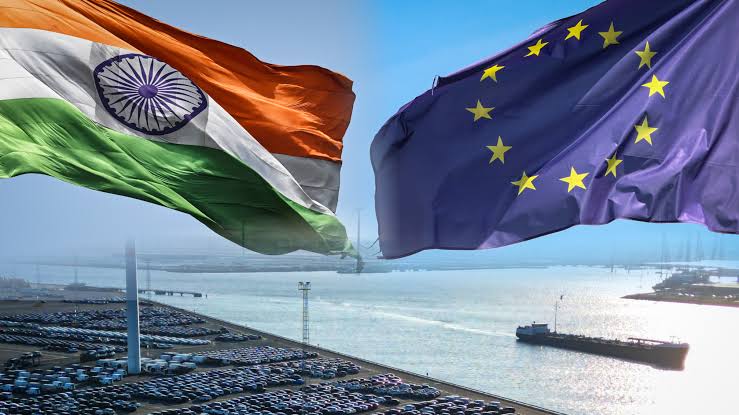
New Delhi: India has entered a new phase of global trade engagement in 2026, concluding several major free trade agreements (FTAs) and expanding negotiations with key global partners, according to a statement issued by the Press Information Bureau (PIB) on Thursday.
Citing the UNCTAD Trade and Development Report 2025, the government said India ranks third among Global South economies in trade partnership diversity, with an index score higher than all countries in the Global North. The report underscores India’s growing resilience amid global tariff uncertainties and shifting trade dynamics.
India-EU FTA concluded
A major milestone was the conclusion of negotiations for the India–European Union Free Trade Agreement in January 2026. The agreement, described as the “Mother of All Deals,” provides preferential access across 97 per cent of EU tariff lines, covering 99.5 per cent of trade value.
Under the pact, 70.4 per cent of tariff lines—accounting for over 90 per cent of India’s exports to the EU—will see immediate duty elimination. Labour-intensive sectors such as textiles, leather, footwear, tea, coffee, spices, gems and jewellery, marine products and toys are expected to benefit significantly. The EU has also extended services commitments across 144 subsectors, including IT, professional and education services.
Sensitive sectors such as dairy, meat, poultry and cereals have been safeguarded, the government said.
FTAs with UK, Oman, New Zealand
During FY 2025-26, India concluded trade agreements with the United Kingdom, Oman and New Zealand.
The India–UK Comprehensive Economic and Trade Agreement (CETA) provides duty-free access to nearly 99 per cent of Indian exports to the UK and eases mobility for professionals in IT, healthcare, finance and education. The pact also includes a Double Contribution Convention, expected to save over ₹4,000 crore in social security payments.
India signed a Comprehensive Economic Partnership Agreement (CEPA) with Oman in December 2025, granting zero-duty access on 98.08 per cent of Oman’s tariff lines. The agreement includes commitments on traditional medicine and enhanced mobility provisions for professionals.
The India–New Zealand FTA eliminates duties on 100 per cent of tariff lines for Indian exports and includes an investment commitment of USD 20 billion over 15 years.
Operational agreements deepen trade ties
Earlier agreements continue to drive export growth. The India–UAE CEPA, signed in 2022, has helped bilateral trade surpass USD 100 billion in FY 2024-25. The India–Australia ECTA has expanded market access across 100 per cent of Australian tariff lines, while the India–EFTA Trade and Economic Partnership Agreement (TEPA), effective October 2025, includes an investment commitment of USD 100 billion over 15 years and a target of generating one million direct jobs in India.
Negotiations expand with key partners
India is also widening its negotiation agenda. In February 2026, India signed the Terms of Reference for an FTA with the Gulf Cooperation Council (GCC) and launched formal negotiations. The first round of FTA talks with Israel concluded in February 2026.
Discussions are ongoing with the United States under a proposed Bilateral Trade Agreement framework, and negotiations continue with ASEAN, Mexico and Canada.
Domestic measures to boost competitiveness
The government highlighted complementary domestic measures to support exporters, including the Export Promotion Mission, credit guarantee schemes and regulatory relaxations by the Reserve Bank of India. The Union Budget 2026-27 announced steps such as removal of value caps on courier exports, extended timelines for export obligations and streamlined cargo clearance through electronic sealing.
According to the PIB statement, the expanding network of trade agreements and ongoing negotiations positions India as a central player in shaping contemporary trade architecture, aimed at boosting exports, attracting investment and generating employment as part of its long-term economic growth strategy.