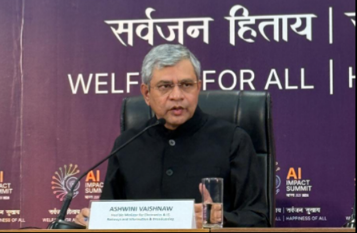
New Delhi: India will add 20,000 additional Graphics Processing Units (GPUs) to its existing artificial intelligence (AI) compute infrastructure in the coming weeks, Union Minister for Electronics and Information Technology Ashwini Vaishnaw announced on Monday at the India AI Impact Summit 2026.
With this expansion, India’s total GPU capacity will rise from over 38,000 to more than 58,000 units, marking what the government described as the next phase of its AI strategy. The announcement was made during the second day of the summit, being held at Bharat Mandapam in New Delhi from February 16 to 20.
The expansion is part of the ₹10,300-crore IndiaAI Mission, which aims to democratise access to advanced computing resources. Under the mission, high-end GPUs are currently being made available at ₹65 per hour to startups, researchers, students and public institutions, lowering entry barriers for AI innovation.
Vaishnaw said the scaling up of compute capacity reflects India’s intent to position itself among the world’s leading AI nations. He described artificial intelligence as a transformative force driving what he termed the “fifth industrial revolution,” with applications spanning agriculture, healthcare, education, manufacturing, governance and climate action.
The Summit was inaugurated on February 16 by Prime Minister Narendra Modi. Officials said the event has drawn over 20 Heads of State, 60 ministers and more than 500 global AI leaders, making it one of the largest AI gatherings globally.
The minister also expressed optimism that over $200 billion in investments could flow into India’s AI ecosystem over the next two years, with venture capital firms increasing commitments to deep-tech startups across the AI stack.
India’s sovereign AI models were highlighted as a major feature of the summit, with several systems benchmarked against leading international models and reported to have performed competitively across multiple parameters.
According to government officials, India has also been ranked among the top three AI nations globally by Stanford, reinforcing its growing stature in the field. The enhanced compute capacity is expected to strengthen India’s ability to support large-scale AI research, model development and public-sector applications.
In addition to infrastructure expansion, the government launched six sectoral AI Impact Casebooks documenting over 170 deployed and scalable AI innovations across sectors including health, energy, education, agriculture, gender empowerment and accessibility.
Discussions at the summit have focused on responsible and inclusive AI adoption, structured around themes such as human capital development, safe and trusted AI governance, sustainability, democratisation of AI resources and economic growth.
Officials said the addition of 20,000 GPUs signals India’s move from incremental progress to infrastructure-led scale, aimed at combining technological ambition with broader goals of welfare, productivity and inclusive growth.