Ziraat Times News Desk
Jammu: Floriculture in Jammu and Kashmir is at a critical juncture, with flower growers calling for focused government intervention to address long-pending structural and policy issues affecting the sector’s growth and sustainability.
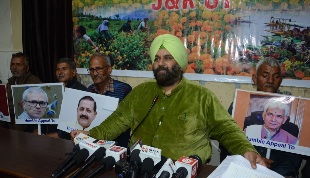
Flower growers from different parts of the Union Territory assembled in Jammu on Tuesday to discuss the current status of the commercial floriculture industry and to highlight challenges faced by the sector. Addressing the gathering, Tejinder Singh Wazir, Member of the J&K Kissan Advisory Board, said floriculture is a billion-dollar global industry driven by nursery production, cut flowers and loose flowers used for devotional purposes.
He said that while the floriculture sector in Jammu and Kashmir is valued at nearly ₹500 crore, it continues to remain under-prioritised in planning and implementation by the UT administration. Referring to budgetary figures, Wazir said the sector remains disorganised, noting that even during the current budget session, flowers were imported from outside the Union Territory despite the government’s emphasis on the “Vocal for Local” initiative.
Wazir pointed out that Jammu and Kashmir continues to depend on imports of tulips and trillions of flower bulbs annually, despite reports by ICAR and CSIR identifying Kashmir as a key destination for flower bulb production in India. He said the failure to tap this potential has limited employment generation and investment, adding that floriculture is often viewed merely as an aesthetic activity rather than a sustainable livelihood option.
Calling the situation a serious concern, Wazir urged UT-level initiatives such as a blanket ban on the import of flower bulbs for public sector use and the development of theme-based gardens—including guldaudi, lupins and bougainvillea—with the involvement of local growers.
He also raised concerns over the implementation of agriculture-related schemes such as MIDH, HADP and JKCIP, stating that these are being handled by multiple departments under the Agriculture Production Department, leading to confusion, overlap and poor coordination. He noted that unlike other states where a single horticulture department oversees such programmes, the fragmented approach in Jammu and Kashmir has resulted in weak and inadequately structured floriculture components.
Wazir said the lack of effective convergence between line departments and research institutions has created gaps in the supply of quality planting material, protected cultivation infrastructure, post-harvest management and market linkages. He stressed that scheme components must be designed strictly according to the needs of flower growers and within prescribed norms.
Emphasising sustainability, he called for interest subvention, revival of sick floriculture units and timely distribution of quality planting material, particularly for loose flowers. He said a budgetary provision of even ₹50 crore could significantly improve the prospects of floriculture farmers. He also sought an assessment of spending and outcomes related to post-harvest management and the absence of dedicated floriculture marketing infrastructure in the UT.
While welcoming top-up subsidies for micro and sprinkler irrigation amounting to ₹116.86 crore, growers demanded a dedicated floriculture mission with enhanced subsidies and insurance coverage. Wazir also referred to the CSIR Floriculture Mission implemented under the leadership of Union Minister Dr Jitendra Singh, citing it as an example of how mission-mode scientific interventions can strengthen the sector.
He urged the organisation of Pushp Kranti Melas in Jammu and similar events in Kashmir to bring together growers, nurserymen, scientists and buyers for coordinated planning. Growers reiterated that the floriculture industry requires quality, quantity and continuity, and appealed for timely and targeted interventions to ensure sustainable growth.
The growers also appealed to Union Minister Dr Jitendra Singh, Chief Minister Omar Abdullah and Agriculture Production Minister Javid Ahmed Dar to initiate coordinated efforts and convene a special review meeting to strengthen floriculture components under various schemes, including HADP, to ensure tangible benefits reach growers across the Union Territory.