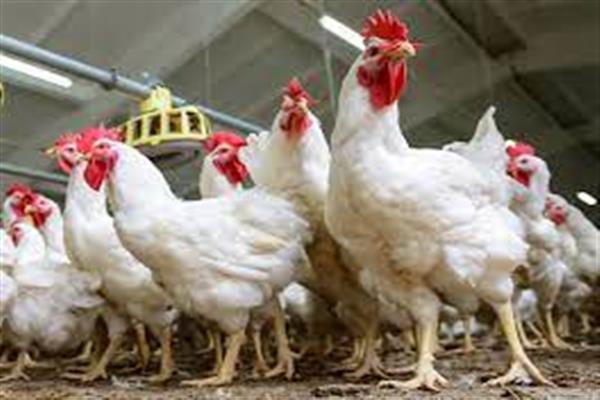
Srinagar: The Federation of Chambers of Industries Kashmir (FCIK) has raised serious concerns over what it described as the steady decline of Kashmir’s poultry industry, urging the government to introduce urgent policy measures to revive a sector that once met nearly 85 per cent of the Valley’s chicken consumption.
In a statement, FCIK said that until 2014, Kashmir had achieved a high degree of self-sufficiency in poultry production due to calibrated government interventions. It credited the imposition of toll tax on imported poultry and the abolition of tax on one-day-old chick imports as key measures that strengthened the competitiveness of local producers.
However, FCIK said that post-2014, policy support was gradually withdrawn. The implementation of the Goods and Services Tax (GST) in 2017 and the abolition of toll and entry taxes led to a surge in outside imports, placing local producers in direct competition with large suppliers from outside the region.
The situation, according to FCIK, further deteriorated after the 2019 reorganisation of Jammu and Kashmir. It alleged that the entry of dressed chicken from “unknown and unverified sources” raised both economic and public health concerns. The organisation acknowledged that the administration had recently intervened to curb the inflow of allegedly unhygienic dressed poultry.
FCIK said that the poultry ecosystem currently comprises more than 7,000 producers across 10 districts, supporting rural livelihoods and allied sectors such as feed supply, veterinary services, transport and local trade networks.
While welcoming the Chief Minister’s recent budget announcement emphasising poultry development — including new farms, egg production initiatives and integration with the Holistic Agriculture Development Programme (HADP) — FCIK urged that revival efforts should prioritise existing units facing financial stress.
The federation demanded the immediate imposition of a cess on imported poultry equivalent to the earlier toll or entry tax, along with a strict ban on dressed chicken imports. It also called for insurance coverage for poultry farmers, easier credit at agricultural rates, interest subvention, and the establishment of local feed mills and hatcheries to reduce production costs.
FCIK further advocated for a structured revival mission aimed at regaining market share, creating surplus production capacity, developing processing and cold-chain infrastructure, and preparing the sector for export-oriented growth.
Warning that delays in corrective action could permanently weaken the sector, FCIK said Kashmir risks losing a strategic allied agriculture industry that once demonstrated strong potential for self-reliance and rural employment generation.