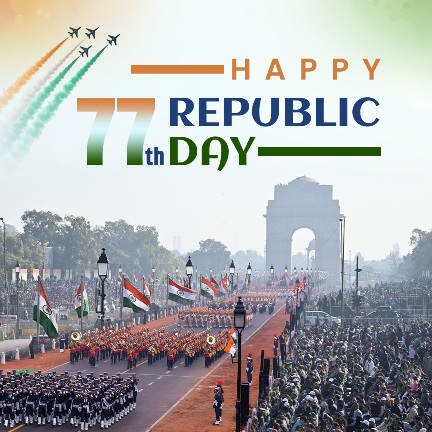
Every year on January 26, the Republic of India stands tall in solemn pride and exuberant celebration. In 2026, the nation marks its 77th Republic Day — a day that resonates across a billion hearts as a symbol of freedom, constitutional ideals, democratic ethos, and unshakable national unity. This is not merely a date on the calendar. It is a living testament to our collective journey from colonial domination to self-governance, from subjugation to sovereign republic. It is a reminder of what we have achieved, who we are, and what we aspire to become. Mubarak to all countrymen on this auspicious occasion, and a burning salute to the visionary leadership of Prime Minister Shri Narendra Modi Ji, whose stewardship continues to guide India toward unparalleled progress and global prominence.
Republic Day is celebrated on January 26 because it marks the day in 1950 when the Constitution of India came into force, replacing the Government of India Act (1935) and transforming the nation into a sovereign democratic republic. Long before independence was achieved, the Indian freedom movement reached a defining milestone on January 26, 1930, when the Indian National Congress declared Purna Swaraj—complete self-rule—rejecting dominion status under British governance. This declaration energized millions and became a symbolic expression of India’s determined quest for full independence.
When the Constituent Assembly adopted the Constitution on November 26, 1949, the leaders consciously chose January 26 as the date of its enforcement, paying homage to that earlier call for sovereignty. Republic Day thus connects the long struggle for freedom with the constitutional destiny of the nation. After independence on August 15, 1947, the task of framing a Constitution that reflected the aspirations of a diverse and plural society fell upon the Constituent Assembly. Under the chairmanship of Dr. B.R. Ambedkar, the drafting committee worked tirelessly for nearly three years to create a framework rooted in justice, liberty, equality, and fraternity. On January 26, 1950, Dr. Rajendra Prasad took oath as the first President of India, and the republic embarked on its historic journey of constitutional governance.
Republic Day is not merely a historical commemoration; it embodies the deepest values of the Indian nation. It symbolizes complete sovereignty and self-governance, affirming that supreme power rests with the people of India. Through the Constitution, the nation declared that citizens would collectively shape their destiny through democratic institutions and the rule of law. Fundamental rights such as freedom of speech, religion, expression, and equality before the law form the backbone of this system, while an independent judiciary and separation of powers safeguard democratic balance. Republic Day reminds every citizen of the importance of preserving these values.
In a land of innumerable languages, cultures, religions, and traditions, Republic Day celebrates unity in diversity—the defining strength of India. It is the moment when cultural plurality harmonizes with constitutional morality, and every Indian, irrespective of creed or class, affirms belonging to one nation.
The grand Republic Day parade at Kartavya Path in New Delhi forms the beating heart of national celebrations. More than a spectacle, it is a narrative of India’s courage, cultural wealth, and forward march. The parade showcases the discipline and strength of the Indian Armed Forces—the Army, Navy, and Air Force—along with paramilitary forces and police units. Marching contingents, mechanized columns, missile systems, and aerial displays collectively demonstrate India’s defence preparedness and resolve.
Equally captivating are the cultural tableaux presented by states and Union Territories. These vibrant floats depict regional heritage, folklore, festivals, historical achievements, and developmental visions, weaving together a powerful image of India’s diversity and unity. The tradition of inviting a world leader as Chief Guest reflects India’s diplomatic goodwill and growing stature as a responsible global power.
While the parade in the capital captures international attention, Republic Day is celebrated across the length and breadth of the country. From villages to metropolitan cities, the national tricolour is hoisted with pride in schools, institutions, and public spaces. Patriotic songs, cultural programs, and community gatherings foster a shared sense of belonging and civic responsibility. The day also honors courage and service through the conferment of gallantry awards and Padma honors, recognizing citizens who have made extraordinary contributions to the nation.
Educational institutions play a vital role in these celebrations, organizing debates, essays, and cultural events that instill constitutional values in the youth. Through such participation, Republic Day becomes not only a celebration but also a lesson in citizenship for future generations.
As India celebrates its 77th Republic Day, reflection on the nation’s progress is inevitable. From a newly independent country to one of the world’s fastest-growing major economies, India’s transformation has been remarkable. Economic empowerment, technological innovation, and aspirations for inclusive growth define the present moment. Social reforms inspired by constitutional ideals have expanded opportunities and sought justice for marginalized communities, reinforcing the moral foundation of the republic.
India’s influence on the global stage has also grown significantly. In an increasingly multipolar world, India’s voice is respected in matters of climate leadership, peacekeeping, global governance, and development cooperation. Republic Day thus stands as a reaffirmation of India’s democratic values both at home and abroad.
On this occasion, a special salute is due to Prime Minister Shri Narendra Modi Ji, whose leadership has reinvigorated national pride and strengthened India’s global standing. Initiatives such as Digital India, Make in India, Startup India, Swachh Bharat, Ayushman Bharat, and transformative infrastructure projects have reshaped India’s developmental trajectory. His emphasis on national security, strategic autonomy, and inclusive growth reflects a vision of a confident and self-reliant India. Above all, his leadership underscores the belief that every citizen, every state, and every community contributes to the nation’s collective progress.
Republic Day also carries a message of responsibility. Alongside fundamental rights, the Constitution outlines fundamental duties—calling upon citizens to uphold constitutional values, respect national symbols, promote harmony, preserve heritage, and contribute to national development. True democracy flourishes not only at the ballot box but in everyday conduct, dialogue, and mutual respect.
As the sun rises on January 26, 2026, and the tricolour flutters in the winter breeze across the nation, Republic Day emerges as the living heartbeat of Indian democracy. It is a celebration of freedom won, sacrifices remembered, rights protected, and responsibilities embraced. It is a pledge to the future—to build a more just, inclusive, prosperous, and powerful India.
Mubarak to every citizen of this extraordinary republic, from the mountains of Kashmir to the seas of Kanyakumari, from the deserts of Rajasthan to the forests of the Northeast. Salute to the indomitable spirit of India—and a special salute to Prime Minister Narendra Modi Ji, whose leadership continues to guide the nation toward its highest aspirations.