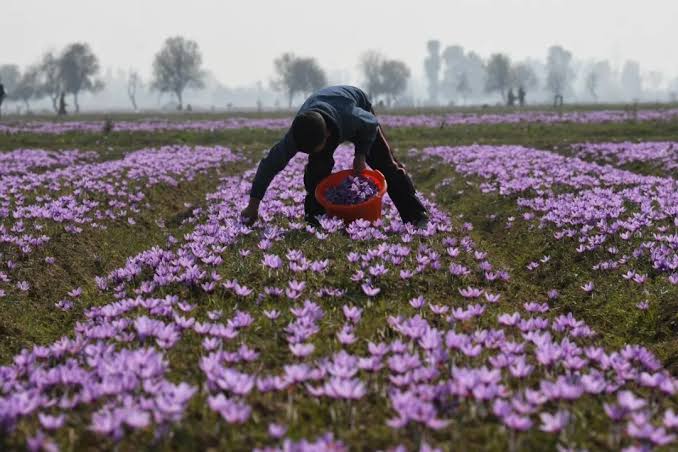
Kashmir’s saffron output has fallen from 15–16 metric tonnes in the late 1990s to less than 5 metric tonnes today, while the area under cultivation has declined from over 5,700 hectares to nearly 3,200 hectares, according to data from the J&K Agriculture Department and the National Saffron Mission. This contraction has occurred despite a ₹411-crore National Saffron Mission (2010–11) and the granting of a Geographical Indication (GI) tag in 2010. The persistent failure lies not in farmer practices or agro-climatic stress alone, but in the absence of a farmer-owned institution that governs price discovery, quality control, and market access. Without such an institution, productivity gains and legal protections fail to translate into farmer income.
The most critical but rarely discussed feature of Kashmir’s saffron economy is how prices are formed. Saffron prices are discovered through opaque, trader-controlled negotiations rather than regulated mechanisms or cooperative procurement. Because saffron is non-perishable and easily storable, inventory power lies with intermediaries rather than producers. Studies on saffron marketing in Kashmir show that over 80 per cent of farmers sell through private traders, often immediately after harvest due to liquidity constraints, while traders hold stock and time market releases. This creates a classic case of structural buyer dominance, not market inefficiency.
Policy responses have consistently bypassed this problem. The National Saffron Mission improved irrigation and promoted scientific cultivation, but did not establish any mechanism for assured procurement or collective marketing. As a result, gains where they occurred were absorbed downstream. Similarly, the GI tag failed to generate sustained price premiums because no producer-controlled body was empowered to enforce quality standards or restrict misuse of the Kashmir label. Evidence of widespread adulteration of “Kashmiri saffron” in domestic markets has been documented repeatedly, eroding brand credibility.
A comparison with Gujarat’s dairy sector illustrates what Kashmir’s policy architecture lacks. In the 1960s, dairy farmers in Gujarat faced fragmented holdings, powerful intermediaries, and volatile prices—conditions strikingly similar to those of saffron growers today. The state’s response was not repeated subsidy programmes, but the creation of a three-tier cooperative structure (village societies, district unions, and a state federation) that directly intervened in procurement, processing, and branding. Today, Amul procures milk from over 3.6 million farmers, assures daily procurement, and returns a significant share of consumer prices to producers. Importantly, Amul altered the structure of the market, not merely farm-level productivity.
Kashmir’s saffron policy did the opposite. Farmers were treated as scheme beneficiaries, not as collective owners of market institutions. Cooperative societies, where they existed, remained under-capitalised, politically influenced, and peripheral to real trade flows. As a result, private traders became the de facto regulators of price and quality—a role that cooperatives elsewhere perform in the interest of producers.
International comparisons further expose this institutional gap. Iran accounts for nearly 85–90 per cent of global saffron production, exporting over 300 metric tonnes annually, according to FAO and Iranian customs data. This dominance is not solely agronomic. Iran operates farmer-linked cooperatives, regulated saffron exchanges, and state-backed export mechanisms that stabilise prices and enforce grading standards. Spain, though producing far less saffron, captures disproportionate value through cooperative-led processing and branding, often re-exporting saffron at multiples of farm-gate prices. Kashmir competes in this same global market without any comparable institutional infrastructure, effectively leaving individual farmers exposed to international price volatility.
The fiscal implications of this institutional absence are significant. Public funds are used to subsidise production, irrigation, and replanting, but without collective marketing, the value created is captured elsewhere. This creates a policy paradox: the state socialises production risks while the market privatises rewards. Over time, this discourages reinvestment in saffron, accelerating crop substitution and land conversion.
What is needed now is not another mission, but institutional sequencing. A saffron cooperative must precede further investments in productivity and branding. Such a body would aggregate produce, conduct transparent auctions, enforce GI standards, invest in testing and packaging infrastructure, and negotiate export contracts. Crucially, it would convert saffron farmers from price-takers into shareholders in the value chain, much as Amul did for dairy farmers.
Kashmir’s saffron did not lose its global relevance; it lost its institutional backing at home. Continuing to frame the crisis as a problem of climate, awareness, or inputs allows policymakers to avoid harder questions of market power and governance. Without correcting the institutional deficit, saffron will continue to decline, not because it cannot grow, but because it cannot compete without a market institution of its own.