In the dim corridors of district record rooms and the crowded verandas of tehsil offices across Jammu & Kashmir, a quiet but deeply unsettling crisis is unfolding. It is not announced by protests or debated loudly in legislatures. Instead, it surfaces through folded jamabandies, trembling hands clutching mutation extracts, and a single recurring question whispered by landholders across the region: We own the land, but why can’t we sell it, mortgage it, or use it?
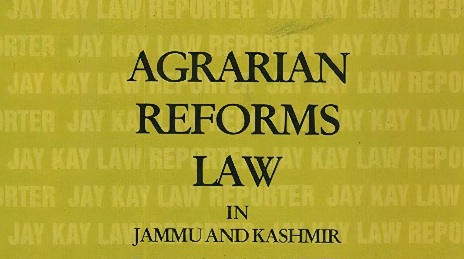
This question reflects the lived reality of thousands of landholders whose land was transferred under section 12 of the Jammu and Kashmir Agrarian Reforms Act. Officially described as prosperity land, this property was meant to ensure dignity and economic upliftment. In practice, it has been rendered legally immobile and economically sterile. While land vested under section 8 of the same Act enjoys full rights of alienation, section 12 land remains frozen, creating a discriminatory divide within a law that was meant to deliver agrarian justice.
This article is shaped not by theory, but by repeated interactions with tenants-turned-owners and successors of original beneficiaries who approach record rooms seeking clarity, not concessions. Their grievance is simple: ownership without usable rights is no ownership at all.
The Agrarian Reforms Act was conceived as a radical corrective to centuries of inequality. It sought to dismantle feudal land relations and transfer land to those who tilled it. Sections 8 and 12 were instruments of that redistribution. Section 8 vested ownership in tenants subject to conditions, while section 12 transferred land as prosperity land to strengthen the economic base of cultivators. On paper, both were empowering. In practice, they have evolved in sharply different directions.
Today, section 8 land is freely alienable. Sale deeds are registered, mortgages are created, banks accept such land as collateral, and families use its value to finance education, healthcare, and enterprise. Section 12 land, however, remains trapped in a legal limbo. Sale deeds are barred, mortgages are prohibited, banks refuse loans, and owners remain paper proprietors with no access to formal credit. This distinction has no rational justification in contemporary governance.
The original rationale for restricting alienation of section 12 land was protective. Lawmakers feared that vulnerable beneficiaries might be forced into distress sales, undoing land reforms. That concern may have been valid in the 1970s. It is untenable in 2026. The children and grandchildren of original beneficiaries are educated, economically active, and fully capable of making informed decisions. Yet they remain bound by restrictions imposed on their forefathers, as though time has stood still.
Protection has thus transformed into paternalism. Safeguards have hardened into shackles. Land labelled as prosperity land has, in many cases, become a source of stagnation. Landholders recount how they could not mortgage land for medical treatment, sell a portion to educate their children, raise capital for modern agriculture, or invest in allied sectors. Many are pushed towards informal moneylenders at exploitative rates. A reform meant to eliminate exploitation has, through inertia, created new forms of it.
In today’s economy, land is not merely soil. It is creditworthiness. When section 12 land is excluded from the banking system, its owners are excluded from development. This is not just a revenue anomaly; it is a developmental injustice that deepens inequality between two classes of beneficiaries created by the same reform law.
The persistence of this anomaly owes much to administrative inertia and fear-driven governance. Revenue officials privately concede that the restriction no longer serves its purpose, yet files do not move and interpretations remain frozen. No authority wishes to be the first to decide. The phrase “no permission exists” becomes the final answer, without any attempt to create one.
At its core, this issue raises serious constitutional questions. Is differential treatment between section 8 and section 12 landholders reasonable today? Does denying economic use of property undermine the right to livelihood? Can ownership without alienation truly qualify as property? Courts may eventually be forced to intervene, but policy reform should not wait for litigation.
What emerges from record rooms is not anger, but fatigue. People are tired of explaining their status to banks, registrars, and officials. They are tired of being told their land is special when that special status only brings disadvantage. They are not asking for subsidies or concessions. They are asking for the right to participate in the economy.
Across India, land reform laws have evolved. Restrictions imposed in the immediate post-reform period have been relaxed once beneficiaries stabilised. Jammu and Kashmir cannot afford to remain trapped in a frozen legal moment. Economic realities, social conditions, and aspirations have changed. The law must follow.
A sensible reform is neither radical nor reckless. It lies in amending the law to permit sale and mortgage of section 12 land after a defined lock-in period, introducing conditional safeguards against distress sales, mandating banking recognition, digitising permissions to eliminate discretion, and harmonising rights between sections 8 and 12. Protection, if retained, must have an expiry date.
Land reform is not an event; it is a process. Section 12 served a purpose once. Today, its rigidity undermines the very spirit of agrarian justice. Ownership without economic freedom is an illusion. Prosperity without autonomy is a contradiction.
If the state truly believes in empowering its citizens, it must trust them. The time has come to unlock prosperity land before it becomes not a symbol of reform, but a reminder of regulatory failure.