

Ziraat Times News Desk
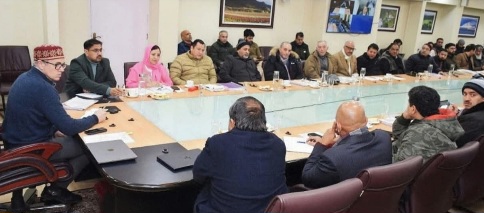
SRINAGAR: The Federation of Chambers of Industries Kashmir (FCIK), the Valley’s apex industrial chamber, presented a substantive pre-budget memorandum to Chief Minister Omar Abdullah on Tuesday. The chamber flagged deep regional and sub-regional imbalances in industrial infrastructure and sought urgent interventions to revive MSMEs, entrepreneurship, and employment across Jammu & Kashmir.
During the interaction, FCIK stressed that the ongoing review of the Industrial Policy must address ground-level distortions. They argued these distortions have led to stress and idleness in existing enterprises, alongside persistent inequalities in industrial activity promotion within limited pockets. The chamber identified 12 critical policy intervention areas considered crucial for the rejuvenation and up-scaling of industrial activity.
Stark Disparities in Land Allocation
FCIK placed detailed data before the Chief Minister highlighting significant geographical gaps in industrial development:
-
Regional Gap: Kashmir region possesses approximately 21,900 kanals of industrial land (existing and upcoming), compared to nearly 29,700 kanals in the Jammu region—a shortfall of over 7,800 kanals.
-
Kashmir Sub-regional Imbalance: Infrastructure is overwhelmingly concentrated in South and Central Kashmir. North Kashmir has just 498 kanals of developed land and 1,828 kanals under development, severely limiting investment.
-
Jammu Sub-regional Imbalance: Growth remains plains-centric. The Chenab Valley has less than 100 kanals with no upcoming estates, while Pir Panjal districts together account for barely 647 kanals.
FCIK stated this skewed distribution reflects a persistent policy bias and called for a shift toward large, contiguous industrial estates in North Kashmir and hilly regions, complemented by activity-based clusters.
Overhaul of Public Procurement & MSME Support
The delegation urged a fundamental overhaul of the public procurement policy. FCIK emphasized that local MSMEs are willing to compete on price with outside suppliers if cost disadvantages are offset through:
-
GST reimbursement on value addition.
-
Interest subvention and exemptions from regulatory charges.
To ensure real market access, the chamber proposed a three-pronged framework:
-
Revival of SICOP for aggregation and distribution of reserved items.
-
MSME-friendly e-tendering with structured purchase preference.
-
Enhanced local filters on the GeM portal to ensure local employment and value addition.
Three-Track Solution for Sick Units
To revive struggling enterprises, FCIK proposed:
-
Restructuring: Revival under the GO 47-IND/RBI framework with government support.
-
NPA Management: A dedicated MSME Asset Reconstruction Company for chronic NPAs.
-
Exit Strategy: A government-led initiative for One-Time Settlement (OTS) to provide stressed units a clean exit from legacy debts.
Agriculture and Immediate Relief Measures
Welcoming the Holistic Agriculture Development Programme (HADP), FCIK urged its implementation in mission mode with adequate budgetary backing, calling the 29-project initiative a “game changer” for rural industrialization.
Immediate relief measures sought by the chamber include:
-
Power Amnesty: A one-time waiver of surcharge, interest, and penalties.
-
VAT Settlement: A statutory “clean slate” for pending VAT arrears from the pre-GST regime, citing previous policy assurances.
Revenue Generation Proposals
FCIK also suggested several avenues for the government to enhance revenue through a multi-pronged approach:
-
Non-intrusive levies: Road tolls, green cess, and progressive vehicle taxes.
-
Hydropower: Rationalization of water usage charges.
-
Natural Resources: Monetization through responsible mining.
-
Public-Private Partnerships (PPP): Infrastructure development in industrial estates, tourism, healthcare, and education.
-
Central Schemes: Aggressive convergence with central funds for MSMEs and infrastructure.
-
Accountability: Strict oversight in fund utilization.