

By: G. R. Sufi (former Information Commissioner, J&K)
This month, I travelled to Bihar as a guest of a prominent personality with a scholarly bent of mind—a prolific reader who once finished reading Aatish-e-Chinar in a single sitting, from 9 p.m. to 5 o’clock the next morning, at my old residence in Rajbagh in the 1980s. I believe it was probably a record.
I had invited my batchmate and friend of Bihar origin—presently settled in Mumbai after his retirement as Principal Chief Commissioner of Income Tax, Mumbai—to accompany me during my visit. I have been travelling since 1972, but on this occasion an extraordinary ordeal occurred. Due to the unbridled market economy and airline mismanagement, my IndiGo flight, which was scheduled to land in Patna on the evening of December 3, 2025, finally touched down at Patna Airport at 3:45 a.m. on December 4. I accepted this unexpected and quarrelsome hardship with patience.
Despite this, my Bihar visit was extremely pleasant and filled with gratitude towards my esteemed host. On December 5, we began our journey to Rajgir in Nalanda district—an ancient civilisational centre and former seat of power of the Magadha Empire, renowned as one of the earliest and most important sites associated with Mahatma Buddha. After spending two days visiting the historic sites of Nalanda, we returned to Patna for a night halt. The following day, we set out for Islampur, where Bihar’s connection with Kashmir exists—specifically in a small, dusty village called Biswak.
 We reached Biswak around 11:00–11:30 a.m. Before reaching our destination, I was pleasantly surprised when Mr Mandal, a senior constable of the escort, asked me:
“Sir, are you going to see the samadhi of the Kashmiri Shasak?”
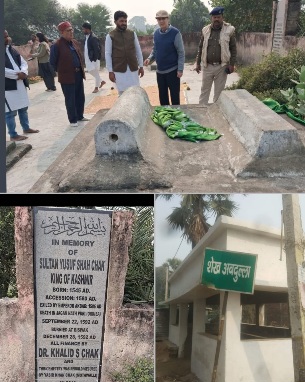
As we approached the sepulchre, Mr Mandal stopped the escort vehicle and my driver halted our car. He then drew my attention to a roadside plaque indicating the direction of “Sheikh Abdullah Road”. I was informed that this road—leading towards Biswak and the graveyard—had been named after Late Sheikh Mohammad Abdullah, who had visited Biswak, as shown in the attachment with this post.
Upon our arrival, we were warmly received by the local Tehsildar, police officials, and local residents—both Hindu and Muslim brothers and sisters. Among the Muslim residents was Mr Chak, brother of Yasir Khan Chak, who has installed the visible plaque on the grave of Late Yousuf Shah Chak, as shown in the attachment with this post.
I wanted to meet Mr Yasir Chak, but I was told by his brother that he was out of station. I was both shocked and surprised to find that there was no visible trace in the graveyard of the ceremony earlier conducted by the J&K Academy of Art, Culture, and Languages. The graveyard contains only five or six graves. Local Muslims, who claimed to be descendants of the Chak dynasty, informed me that along with Yousuf Shah Chak, his son Yaqoob Shah Chak and other descendants were also buried there.
However, I am not fully convinced about the veracity of the claim that Yaqoob Shah Chak is buried at this site. More strikingly, even those who claimed to be living descendants of the Chak dynasty did not utter a single word about the grave of Habba Khatoon.
I do not claim to be a historian, but I remain a fervent student of history. I leave it to Kashmiri historians to finally determine the historical truth regarding the burial locations of Yaqoob Shah Chak and Habba Khatoon.
I had no intention of writing about this Bihar visit, but my friend Mr Saleem Beig insisted that I document my visits to Patna and Biswak. I may write another post later about my sojourn, reflecting on the political, social, and economic conditions of the state of Bihar.
To be continued..
Comments are closed.