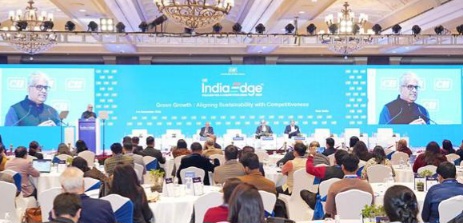
New Delhi, December 3 — Union Environment Minister Bhupender Yadav today underscored India’s push toward sustainable and globally competitive economic growth, while addressing a Special Plenary on “Green Growth: Aligning Sustainability with Competitiveness” at CII IndiaEdge 2025 in the capital.
Speaking at the event, the Minister said that India’s economic trajectory under Viksit Bharat@2047 is increasingly shaped by green technologies, resilient manufacturing practices, and sustainability-driven policies. “Clean industrialisation is not a constraint; it is a catalyst for economic expansion, innovation, resilience and future prosperity,” he said, adding that decarbonising India’s manufacturing sector is essential for ensuring export competitiveness and avoiding future carbon-based trade barriers.
Reforms to Drive Green Industrial Transformation
Yadav outlined several recent reforms aimed at accelerating India’s green industrial transition. He highlighted the GST 2.0 reforms, which reduced tax rates on renewable energy equipment, biodegradable plastics, effluent treatment plants and electric vehicles from 12% to 5%. The move, he said, creates a strong incentive for industry to invest in green manufacturing and adopt eco-friendly practices across supply chains.
He also cited major initiatives such as the Scheme to Promote Manufacturing of Sintered Rare Earth Permanent Magnets (REPM), the National Critical Mineral Mission 2025, the revised Green Credit Programme, and the Environment Audit Rules 2025 as key drivers of India’s sustainability agenda.
Calling for deeper corporate participation, Yadav urged industry leaders to partner with the government to scale green technologies and carve out a competitive edge for India. “Industry must seize this opportunity to invest in green manufacturing and collaborate for global competitiveness,” he said.
India’s Climate Priorities Reflected at CoP30
Sharing insights from the recently concluded CoP30, the Minister said the conference outcomes aligned with India’s expectations. “The 29 decisions adopted by consensus clearly reflect India’s priorities across climate finance, unilateral trade measures, technology and just transition,” he said. He also noted the establishment of the Technology Implementation Programme and new institutional frameworks to support just transition.
Circular Economy and EPR to Unlock Green Jobs
Yadav highlighted the transformative potential of the Circular Economy and Extended Producer Responsibility (EPR) framework in reshaping industrial sustainability.
“EPR builds sustainable waste ecosystems, boosts recycling revenues, formalises informal workers, and can unlock 33 lakh new jobs, creating a green-skilled workforce,” he said, urging companies to take voluntary measures that strengthen India’s shift to a self-reliant circular economy.
He also acknowledged CII’s contributions, adding that initiatives like an output-based Circular Economy PLI, strengthened EPR systems, and Green Public Procurement could accelerate recycling and support Atmanirbhar Bharat.
A Call for Industry–Government Collaboration
Emphasising the role of innovation and R&D, the Minister encouraged industries to integrate sustainability with competitiveness through technological upgrades, green manufacturing practices, and partnerships with MSMEs.
“India’s journey toward Viksit Bharat@2047 is not just about growth; it is about inclusive, resilient and sustainable prosperity,” he concluded.
Senior CII officials including Director General Chandrajit Banerjee, Shiv Siddhant Narayan Kaul, and Masood Alam Mallick were present during the plenary.