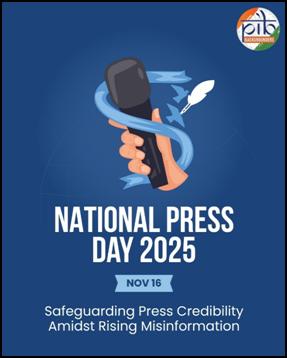
New Delhi, November 16: India marked National Press Day today, commemorating the establishment of the Press Council of India (PCI) and reaffirming the essential role of a free and responsible press in strengthening democracy. Observed every year on November 16, the day highlights the media’s role as the fourth pillar of democracy, shaping public opinion and ensuring transparency and accountability.
According to official data shared by the Ministry of Information and Broadcasting, India’s media landscape has continued to expand significantly. The number of registered publications has risen from 60,143 in 2004–05 to 1.54 lakh in 2024–25, underscoring the growing reach of print media across the country.
The government also highlighted major legal and digital reforms introduced to modernize the media sector. These include the Press and Registration of Periodicals (PRP) Act, 2023, and the Press Sewa Portal—an online platform that has digitized and streamlined the registration of periodicals. Within six months of its launch, the portal onboarded 40,000 publishers, registered 3,000 presses, and processed over 37,000 annual statements, offering real-time tracking, e-sign services, QR code-enabled certificates, and integrated payment gateways.
National Press Day also saw the presentation of the National Awards for Excellence in Journalism, which honour outstanding contributions across various fields of print media. The prestigious Raja Ram Mohan Roy Award remains the highest recognition.
Reflecting on its origins, the government noted that National Press Day commemorates the reconstitution of the Press Council of India in 1979. The PCI, a statutory autonomous body, is empowered to safeguard press freedom, maintain journalistic standards, hear complaints, and issue guidelines. Over the years, the Council has issued norms against fake or defamatory news, framed disaster reporting guidelines, and promoted inclusive representation—such as 2023 guidelines on LGBTQ+ coverage. It also conducts internship programs to train aspiring journalists and engages internationally through MoUs with press councils from neighbouring countries.
Alongside regulatory initiatives, institutions such as the Indian Institute of Mass Communication (IIMC)—now a deemed university—continue to expand journalism education through postgraduate programs in multiple Indian languages and specialised courses, including Sanskrit journalism.
The government also reiterated its commitment to journalist welfare through schemes providing financial assistance for medical emergencies, disability, and death under extreme hardship. Journalists are covered under social security provisions of the Employees’ Provident Fund and ESI Acts where applicable.
National Press Day 2025 was observed across the country with discussions, award ceremonies, and the release of the annual Souvenir, containing messages from leaders and articles from media experts. Officials said the day serves as a reminder of the press’s continuing responsibility to inform, educate, and empower citizens while upholding ethical standards.


Comments are closed.