As the Gulmarg Development Authority orders eviction of Hotel Nedous in Gulmarg, following the dismissal of the Special Leave Petition (SLP No 28599/2018) by the Supreme Court of India and the High Court of Jammu and Kashmir’s order dated September 6, 2018 (OWP No 847/2015), Ziraat Times reproduces a part of the book “Kashmir: Looking Back in Time (Politics, Culture, History)” by eminent historian and former J&K government senior civil servant Khalid Bashir Ahmad, providing a glimpse into the history of the hotel:
The Nedous Hotel, one of Gulmarg’s most iconic landmarks, holds the distinction of being the first hotel established in the verdant meadow. It was founded in 1888 by Michael Adam Nedou, an enterprising hotelier from Dubrovnik (now in Croatia), who had already opened properties in Lahore and Kashmir. His son, Michael Henry Nedou, also known as Harry, converted to Islam and married Mir Jan, a local Muslim Gujjar woman.
Their only child, Akbar Jahan, would go on to marry Sheikh Mohammad Abdullah, the charismatic leader who would shape Kashmir’s political destiny in the 20th century.
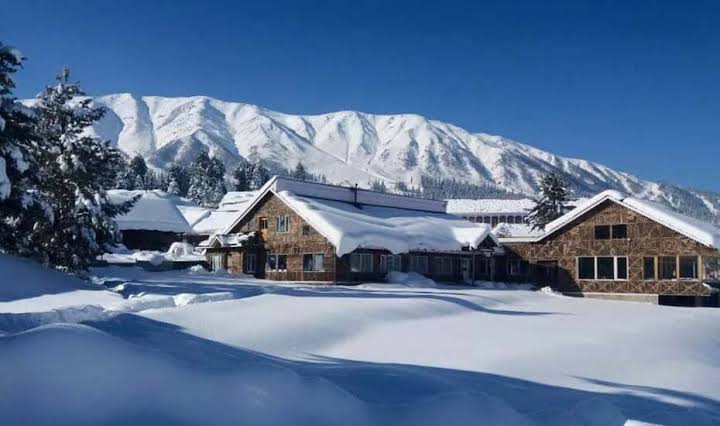
Nestled beside a lush golf course with a striking view of Mount Apharwat, Nedous Hotel offers guests “the best of our heritage” and a truly comforting “home away from home.” An old promotional leaflet by M. Nedou & Sons describes the property as being open from 15th May to 30th September, equipped throughout with electric lighting, and featuring large public rooms including a billiards room with a first-class table.
Historically referred to in archival documents as “The Gulmarg Hotel,” the property was leased to Michael Adam Nedou by the penultimate Dogra ruler of Jammu & Kashmir, Maharaja Pratap Singh’s government for an annual rent of Rs. 500. The lease terms required him to maintain the building in good repair, and he was granted Rs. 144 annually to pay two chowkidars. Any damage caused by negligence, on his part or by his employees, was his financial responsibility.
Although the original lease expired on 30 May 1898, no renewal was executed until 1901, at which point the State Engineer noted that the rent was significantly below the rate stipulated by current regulations. The rules dictated that 15% of a building’s total cost should be charged annually, which for the Nedous property, valued at Rs. 26,000, would amount to Rs. 3,900. The Engineer further recommended that Nedou cover the chowkidars’ salaries himself and denied his request for a Rs. 10,000 loan and the free grant of 20 trees for rebuilding part of the hotel.
The government felt it had already shown sufficient leniency, asserting that since the hotel was now “on sound footing,” it should be charged at rates consistent with other Gulmarg properties. On 4 April 1903, Nedou wrote a detailed appeal to Raja Amar Singh, Vice-Chairman of the State Council, expressing his concerns:
“In fixing the rent to be paid for the Gulmarg Hotel, I would venture to state generally, that when I first undertook to open a hotel in Gulmarg and subsequently at Srinagar I had to invest a large amount of capital in furnishing and stocking them and had to accept a heavy risk… Visitors to Kashmir went there to combine pleasure with economy and were not inclined to patronize more or less expensive hotels. The early years yielded meagre profits. Just as I am beginning to make headway… it is proposed to raise the rent to an almost prohibitive figure.”
Nedou pleaded that due to the short tourist season and modest returns from both Gulmarg and Srinagar hotels, the proposed rent hike should be reconsidered. His petition, however, was declined, and the government revised the rent to Rs. 2,000 per annum.
Beyond hospitality, both Adam and Henry Nedou were active in local enterprise. The senior Nedou undertook construction and repair projects, while the younger ran a pony and cart service between Tangmarg and Gulmarg. For years, repairs of the Maharaja’s huts and palaces in Gulmarg were entrusted to Adam Nedou. State Engineer M. Field noted, “This has worked better than interference by the P.W.D. [Public Works Department], and as His Highness desires, it is best this arrangement continue.” In a letter, Nedou lamented that payment for the previous year’s repairs had still not been disbursed.


Comments are closed.