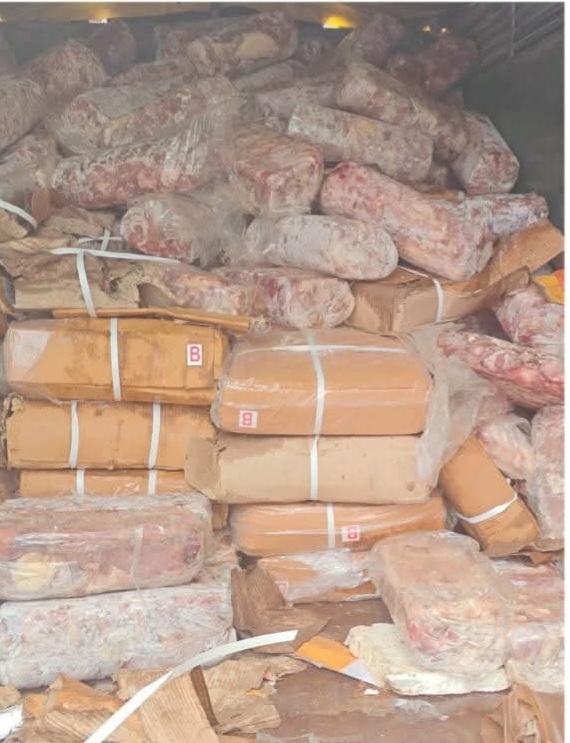
Srinagar — A major food safety debate has rocked Kashmir’s hospitality sector after authorities seized over 1,200 kilograms of rotten meat from a cold storage facility on the outskirts of Srinagar. The incident has triggered alarm among hotel and restaurant owners who now fear both reputational damage and a blow to their businesses.
The Jammu and Kashmir Food Safety Department on Thursday raided a storage unit in Zakura Industrial Estate, where officials discovered large quantities of spoiled meat allegedly supplied to various food outlets in the Valley. The meat, according to officials, was imported from Ghazipur in Uttar Pradesh by a trader and delivered to Sunshine Foods, a local supplier based in Zakura.
The Assistant Commissioner of Food Safety, Hilal Ahmad Mir, confirmed that the meat was being transported in conditions that failed to maintain the optimal temperature necessary for its safe storage. “We received a tip-off and were able to seize 1,200 kilograms of rotten meat. However, it is feared that a larger quantity from the same consignment may have already reached the market,” Mir was quoted as saying. He added that the meat was subsequently sold to another trader based in Batmaloo, Srinagar.
Repeated attempts by the media to contact the owner of Sunshine Foods went unanswered. Officials are continuing their investigation into the full trade chain and have assured action against all those involved in the illegal import and distribution of unfit meat.
The incident has sparked outrage in the hotel and restaurant industry. Asif Siddiqui, Joint Secretary of the Kashmir Hotel and Restaurant Owners’ Association (KHROA), has called on the government to expose the full network behind the scandal and take stringent legal action. “This is not a minor violation. Supplying rotten meat to our hotels and restaurants is criminal and can destroy the hard-earned reputation of our industry. Consumers and tourists will now begin to question the safety of our cuisine,” Siddiqui said.
He further demanded an immediate and full-scale crackdown on “unscrupulous traders” involved in such activities. “We want the government to unravel the entire chain, from the exporter in Uttar Pradesh to the traders in Kashmir. This kind of illegal and unethical trade must be banned altogether,” Siddiqui stressed.
Health and safety concerns are now mounting among residents, as large quantities of meat and fish consumed in Kashmir are sourced from outside states. Naveed Anjum, a Srinagar-based lawyer and social activist, warned that the seizure should not be treated as an isolated incident. “The government must treat this as a serious health hazard. There needs to be an urgent investigation into the entire meat import trade and stricter controls to safeguard public health,” he said.
In a related development, the Food Safety Wing of the Drugs and Food Control Organisation has also intensified its monitoring of food hygiene practices across Srinagar. Forty-four street vendors were fined for violating the Food Safety and Standards Act (FSSA). Items found unfit for consumption were destroyed on the spot, and vendors were cautioned against using newspapers and non-food-grade utensils for packaging and cooking.
As investigations continue, the hospitality sector is urging authorities to treat the matter with the urgency it deserves. Hotel and restaurant owners say they are willing to cooperate with the Food Safety Department, but want immediate action to prevent further damage to their industry’s credibility and Kashmir’s culinary reputation.